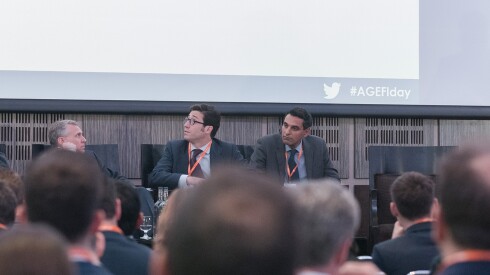
The asset management firm Silk Invest, founded in 2008, is specialised in investment in frontier markets. Currently, the structure managers about EUR100m, of which 55% are for institutionals, and 45% for private investors. Zin Bekkali, CEO and CIO of Silk Invest, explains to Newsmanagers what the attraction of investing in frontier markets is.
The asset management firm Comgest, based in Paris, has recruited its first head of development for Asia, Robert James, Asian Investor reports.James, previously head of development for the institutional unit at First State, joined Comgest earlier this year as managing director and head of development for Australia. He will be based in Hong Kong, and will report to Philippe Lebeau, global head of development based in Paris.
The ETF management firm Wisdom Tree (47 ETFs, USD13.9bn in assets) on 3 february set the price of its public share offering of over 14.36 million shares at USD5.61 per share, for a total of USD80.6m. The offer includes 1 million shares offered by the firm, and 13.36 million shares owned by current shareholders, among them CEO Jonathan Steinberg and chairman Michael Steinhardt.A greenshoe option for over 2.15 million shares held by current shareholders has also been provided for a period of 30 days.
Brice Anger, director of development at M&G Investments in France, has told Investment Europe that assets at the British asset management firm in France total over EUR1.6bn (the same level as eight months ago; see Newsmanagers of 5 May 2011). The Paris team now has seven members, and M&G offers 26 funds in France.
Marie-Jeanne Missoffe is leaving SPGP. The Cap Grande Europe fund which she manages will be entrusted to Philippe Joly, who is already manager of the Sélection Action Rendement fund, which invests in European large caps. Missoffe’s fund, which was hit by its high exposure to the countries of Eastern Europe and now has only EUR3.3m in assets, will be absorbed into Joly’s fund, whose net assets under management are EUR25.5m.
EFG Bank, an affiliate of EFG International in Asia, has appointed Kong Eng Huat as chief executive officer for activities in Singapore and South-East Asia. Be will be based in Singapre, and will also be a member of the board of directors at EFG Bank in Asia. Kong was previously director of Wealth Management activities for the South and South-East Asian regions at Merrill Lynch International Bank.
Adjusted net profits for the Julius Baer group contracted by 21% last year, to CHF401m, while underlying net profits, excluding a taxation agreement with Germany that resulted in a CHF65m charge, fell 10% to CHF452m. Net profits by IFRS accounting standards fell 27%, to CHF258m.The cost/income ratio has deteriorated to 68% from 65.4%, largely due to the appreciation of the Swiss franc. Assets under management as of the end of December totalled CHF170bn, generally the same level as twelve months previously. Julius Baer has posted net inflows of CHF10bn, but these subscriptions have been nearly entirely offset by negative market and currency effects.The Board of Directors will propose an unchanged ordinary dividend at the general shareholders’ meeting on 11 April 2012 of CHF0.60 per share, for a total of CHF118m. In addition, there will be a special dividend of CHF0.40 per share, totalling CHF79m, “in order to directly refund some excess shareholder capital and to take advantage of current Swiss tax legislation,” according to a press release.Julius Baer is also planning to announce a new share repurchase program totalling CHF500m, to be completed in the next two years.
Aylin Suntay, head of small caps at Pictet Asset Management, has left the firm where she spent 10 years, Citywire reports. Her former colleague Bill Barker has assumed her duties. Suntay had been one of the co-managers of the Pictet Small Cap Europe fund, and head of investments for Southern Europe. Alain Caffort, who recently left Groupama Asset Management to join Pictet, has taken over the management of the fund dedicated to small caps, alongside Oliver Knobloch and Barker.
According to statistics from Deutsche Bank, European ETPs (ETFs, ETNs and ETCs) have taken on a net total of USD3.3bn, or EUR2.5bn in January 2012, the Börsen-Zeitung reports.Due to market effects, assets in these funds have increased in the space of one month to USD290.1bn (EUR219.1bn), compared with USD269.9bn. As of the end of the fourth week of January, assets in ETFs alone represented USD221.5bn, or EUR167.2bn. The two largest net inflows were for iShares, with USD1.2bn, and db x-trackers/db ETC with USD643m.
Since the absorption of Gesduero by Caja España Fondos, the number of fund management firms in Spain has fallen by 114. Of this total, 15% are currently in the process of merging, Funds People reports. Most of these candidates for mergers are logically affiliates of savings banks (cajas de ahorro).Currently, 55% of asset management firms are owned by financial institutions (banks and savings banks), 38% are independent, and 7% are owned by insurance companies.
Legg Mason Global Asset Management has launched a multi-stratgy bond fund of hedge funds, entitled Permal Hedge Strategies Fund, Hedge Week reports. The fund is managed by Javier Dyer, and will have 20 to 40 positions.The new product will use several bond strategies, with flexible asset allocation, and investments in emerging market debt, long/short bonds, event-driven strategies and global macro. The manager may use funds from both systematic and discretionary managers, in order to limit volatility.
The New York-based asset management firm Van Eck Global has notified the SEC of plans to launch seven new ETF funds, Mutual Fund Wire reports.The new products are the following:Emerging Markets US$ High Yield Bond ETF,Fallen Angel US$ Bond ETF,Global Fallen angel Bond ETF,Global High Yield Bond ETF,Global High Yield US$ Bond ETF,International High Yield Bond ETF andInternational US$ High Yield Bond ETF.
OppenheimerFunds has announced the launch of the Oppenheimer Global Multi Strategies fund. The multi-strategy fund is based on a quantitative and fundamental approach, in order to generate returns by isolating market performance (market neutral) which is uncorrelated to more traditional strategies. The product is managed by Caleb Wong.
Due to a depreciation of nearly 60% for an investment in LightSquared, the main hedge fund from Harbinger Capital Partners saw losses of 47% last year, the Wall Street Journal reports. This loss resulted in a decline in total assets at the management firm to USD4bn as of the end of 2011, compared with a peak of USD26bn at the end of 2008.
BlackRock has notified the SEC that it plans to launch two iShares ETF funds of emerging market bonds, one of them corporate bonds, the iShares Emerging Market Corporate Bond Fund, and the other high yield bonds, the iShares Emerging Markets High Yield Bond Fund, the Börsen-Zeitung reports. The two funds physically replicate Morningstar indices.
On 2 February, the NYSE-Arca platform admitted five more ETFs from iShares (BlackRock) to trading. They are equity products replicating MSCI indices covering producers of commodities worldwide. All of them charge 0.30%.The funds are as follows:- iShares MSCI Global Agriculture Producers Fund (acronyme NYSEArca: VEGI)- iShares MSCI Global Energy Producers Fund (FILL)- iShares MSCI Global Select Metals & Mining Producers Fund (PICK)- iShares MSCI Global Gold Miners Fund (RING) and- iShares MSCI Global Silver Miners Fund (SLVP)
RBC Dexia Asset Management on 2 February announced that it is launching four bond funds, sub-advised by BlueBay Asset Management. The products (one of which is based on emerging markets corporate debt, one on emerging markets bonds, one on convertibles, and one on high yield), will be available to institutional investors and high net worth private clients in the United States. The minimal investment is USD1m.
Several British media sources are reporting that Aberdeen Asset Management has asked IFAs to remove its offshore (GBP6bn) and onshore (GBP2.7bn) emerging markets funds from their lists of recommendations and to cease promoting these funds from 1 April. The asset management firm is also considering further measures, such as increasing commissions, or discontinuing subscriptions to some share classes.Net subscriptions are already frozen for segregated accounts, and the size of these accounts has been capped.Aberdeen says it is hoping to avoid to completely suspending subscriptions, but emphasizes that the objective is to protect performance and prevent the funds from confronting liquidity problems with some of their investments.
As of the end of December, assets in British-registered funds fell to GBP571bn, from GBP586.5bn twelve months previously. Retail net subscriptions last year fell to GBP18bn, comapred with GBP29.3bn in 2010. Subscriptions originating from Individual Savings Accounts (ISAs), for their part, have fallen to GBP2.9bn, compared with GBP4.2bn, the Investment Management Association (IMA) reports.Richard Saunders, CEO of the IMA, says that investors were highly prudent in second half, with outflows from equity funds and larger inflows to bond and diversified funds. Meanwhile, funds domiciled abroad in 2011 posted record net subscriptions, with GBP1.7bn for retail, compared with GBP1.4bn the previous year. As of the end of December, their assets totalled GBP32.3bn, compared with GBP27.5bn as of the end of 2010. Their market share represented 5.4%, though it was only 3.7% four years earlier.Institutional funds, for their part, have posted net subscriptions of over GBP1.78bn in 2011, compared with net outflows of GBP2.11bn the previous year.
Arnaud Simon, gérant-sélectionneur de fonds à La Banque Postale, dans une table ronde organisée par amLeague et Newsmanagers, le 18 janvier 2012: Notre particularité est d’investir une partie des fonds propres de la Banque Postale sur des actifs de diversification. Nous investissons sur des actions, sur de la gestion alternative, des matières premières, du private equity et de l’immobilier. Et cela uniquement sous forme d’ETF ou d’OPCVM, dédiés pour la gestion alternative, mais pas pour les actions où nous sommes acheteurs de fonds ouverts. À la base, lorsqu’on a lancé notre projet de diversification, il y avait un débat entre ETF et gestion active. J’ai été recruté pour diversifier avec de la gestion active. 2011 est un peu la redite de 2008. De nouveau, on s’aperçoit que c’est bien de faire du stock picking mais pour nous, acheteurs de produits externes ou de produits de gestion active, on voit que le match est très difficile entre acheter des ETF et acheter des fonds. Il ne faut pas se tromper ! Mon sentiment d’investisseur, est que le bon seuil de tolérance, de résistance à la douleur sur un choix de gérant actif, est proche -10 % par rapport à son benchmark. Nous pouvons l’encaisser, mais cela devient limite. Tout ce qui va au-delà va nous faire réfléchir sur tel ou tel type de société de gestion. Nous pouvons le faire parce que nous sommes allocataire d’actifs. On ne fait pas du trading mais de l’investissement pour compte propre. Mais c’est vrai qu’on essaie d’optimiser nos investissements en ayant une vision un peu économique. En revanche, nous sommes persuadés que la gestion active apporte par rapport aux ETF. On en est persuadé. On est sûr aussi qu’il y a de la volatilité dans la génération d’alpha. 2011 illustre cela de manière criante.
En 2011, l’assureur Aréas qui gère près de 2 milliards d’euros d’actifs a remis à plat sa stratégie de gestion obligataire. Jusqu’alors, l’assureur gérait en direct l’ensemble de son portefeuille obligataire, soit 500 millions d’euros. Désormais, aidé par un consultant, Areas a fait le choix d’externaliser complétement cette gestion. Un appel d’offres a été lancé en 2011 aboutissant à la sélection de trois gestionnaires de mandats. Il s’agissait aussi de se conformer aux nouvelles exigences de Solvabilité II, dans le pilotage des contraintes de SCR, et gestion des risques. Areas continue de détenir des fonds dédiés sur des montants plus faibles, notamment sur les autres compartiments du portefeuille, à savoir les actions (33% de l’ensemble) et l’immobilier (33% également).
Le patron de l’opérateur boursier allemand, Reto Francioni, estime dans un entretien accordé au Financial Times Deutschland qu’il ne pourra survivre à terme sans nouer des alliances, après l’échec du rapprochement avec Nyse Euronext. Le dirigeant n’a aucune intention de démissionner ou de renoncer à son bonus. Il songe à attaquer en justice la décision de la Commission européenne de bloquer la fusion, Bruxelles ayant en prétextant une position dominante dans les dérivés ignoré les montants énormes échangés de gré à gré entre les banques.
Le groupe français ainsi qu’un partenariat entre le fonds Carlyle Group et le fonds souverain Qatar Investment Authority (QIA) font la course en tête pour prendre près de 40% de l’opérateur d’aéroports turc TAV Havalimanlari, ont déclaré vendredi à Reuters trois sources proches du dossier. TAV gère dix aéroports dont celui d’Istanbul Ataturk.
La banque suisse Raiffeisen, qui a racheté sa rivale Wegelin, est en train de couper les ponts avec ses propres clients liés aux Etats-Unis sur fond de lutte contre l’évasion fiscale outre-Atlantique. « Notre activité n’a jamais été focalisée sur eux. Nous ne donnons également plus aucun relevé bancaire en anglais», a expliqué Pierin Vincenz, le directeur général de Raiffeisen, au SonntagsBlick.
Le yen continue à monter face aux principales devises, s’approchant face au dollar du niveau qui pourrait déclencher une nouvelle intervention de la BoJ.