« Patisserie Valerie », voilà un nom bien français pour une spécialité qui fait fureur ces derniers temps au Royaume-Uni : la fraude comptable, une pratique que les Anglais traduisent par une métaphore culinaire très appropriée, « to cook the books ». La chaîne britannique, dont la holding est cotée en Bourse, a découvert un trou de plus de 20 millions de livres dans ses comptes, sans oublier quelques arriérés d’impôt que le fisc de Sa Majesté lui réclame. Cette fois, c’est le cabinet Grant Thornton qui est montré du doigt. De Tesco à Carillion, la liste des scandales comptables n’en finit donc pas de s’allonger outre-Manche, imposant une réforme rapide de la tutelle du secteur et des Big Four de l’audit. Il faut dire que la crème anglaise commence à se révéler indigeste pour les investisseurs.
Moody’s a maintenu la note « AAA stable » de la dette publique des Etats-Unis. Pour l’heure, des trois grandes agences de notation, seule S&P a dégradé les Etats-Unis en 2011 à « AA+ ». Mais Moody’s prévient : les inégalités de revenus croissantes aux Etats-Unis sont une considération sociale clé qui peut affecter le profil de crédit du pays à travers plusieurs critères de notation aussi bien institutionnels, économiques que fiscaux. Les inégalités croissantes rendent politiquement plus difficile le redressement de la dynamique budgétaire à moyen terme. Avec les monumentaux déficits budgétaires fédéraux prévus au cours des prochaines années, les Etats-Unis sont prévenus.
Deux fois l’an, le Trésor américain publie son rapport sur les politiques de changes des partenaires commerciaux des Etats-Unis. Ces six derniers mois, le yuan s’est déprécié de 9 %, annulant une bonne partie des effets des hausses de taxes sur les importations chinoises décidées par Donald Trump. Cette fois encore, le Trésor n’accuserait pas la Chine de manipulation de sa devise. Mais le secrétaire au Trésor, Steven Mnuchin (photo), serait prêt, dit-on, à passer outre l’avis de ses services. La dernière labellisation « manipulateur » remonte à 1994 et concernait… la Chine.
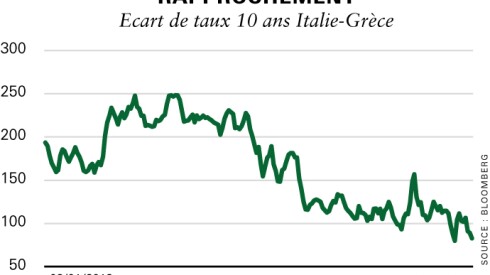
Dégradation. Jour après jour, la dette souveraine italienne s’éloigne de ses homologues du clan « Périphériques » dans laquelle elle était classée il y a encore quelques mois avec l’Espagne et le Portugal, pour se rapprocher de la mal notée, la Grèce. Quelque 250 points de base (pb) séparaient les rendements à 10 ans italien et grec début avril, reflétant les différences de notes accordées par les agences de notation à chacun des deux pays. L’écart s’est réduit à 85 pb ces derniers jours. Le jugement du marché est sans appel. Il exprime sa conviction que la politique budgétaire de Rome va conduire les agences de rating à dégrader la dette publique italienne. Deux économistes de Natixis, Camille Neuville et Cyril Regnat, en sont eux aussi convaincus : « Au vu du ton agressif adopté par le gouvernement italien envers ses engagements européens, l’issue la plus probable est une dégradation de la note de l’Italie à BBB-, avec ‘outlook’ stable », écrivent-ils dans une note. Ils envisagent un spread Bund-BTP jusqu’à 400 pb pour le scénario le plus défavorable. Moody’s et S&P donnent leur verdict fin octobre 2018, Fitch en mars 2019.
Les investissements directs étrangers (IDE) mondiaux ont chuté de 41 % au premier semestre de l’année. Ils sont passés de 800 milliards de dollars (six premiers mois de 2017) à 470 milliards. Explication de la Cnuced qui publie ces chiffres : cette chute est due en majeure partie aux rapatriements aux Etats-Unis des bénéfices accumulés à l’étranger par les filiales des entreprises américaines. Bref, c’est la conséquence de la réforme fiscale de Donald Trump.
Smithson, la nouvelle société d’investissement cotée (investment trust) de Terry Smith, a levé 822,5 millions de livres (935 millions d’euros) à l’occasion de son introduction à la Bourse de Londres, bien au-dessus de l’objectif initial officiel de 250 millions de livres et de la cible révisée à 600 millions. Smithson bat ainsi le record pour ce genre d’opération, détenu par Patient Capital. La société d’investissement de Neil Woodford avait levé 800 millions de livres il y a trois ans. Le nouveau fonds sera géré par Simon Barnard et Will Morgan. Terry Smith, connu pour ses stratégies d’investissement stock picking, sera chief investment officer. Il investira dans des sociétés small et midcaps, trop petites pour intégrer Fundsmith Equity, le fonds amiral de Terry Smith. Ce dernière gère actuellement 14 milliards de livres.
Smithson, la nouvelle société d’investissement cotée (investment trust) de Terry Smith, a levé 822,5 millions de livres (935 millions d’euros) à l’occasion de son introduction à la Bourse de Londres, bien au-dessus de l’objectif initial officiel de 250 millions de livres et de la cible révisée à 600 millions. Smithson bat ainsi le record pour ce genre d’opération, détenu par Patient Capital. La société d’investissement de Neil Woodford avait levé 800 millions de livres il y a 3 ans.
Crux Asset Management has appointed Philip Howard of Penrith as chairman, the company announced.Howard served as senior independent director of Schroders formerly, having served as a non-executive director since 2008. He also held roles of chief investment officer of Llyods’ insurance branch Beazley and of chairman of Tarchon Capital Management. Another position has been that of deputy to the chairman of Lehman Brothers in Europe until 1997.Consequently, Charles Ferguson steps down as chairman to become a non-executive director for Crux. Crux AM was founded in 2014.
The independent asset management firm Sunny Asset Management (Sunny AM) on 16 October announced three new arrivals. In addition to Kévin Gameiro, whose appointment as high yield manager and analyst was announced in July (see NewsManagers of 25 July 2018), the asset management firm has recruited Etienne de Marsac to the newly-created position of head of the absolute return management unit, and Johann Renoult as internal controller. In this role, de Marsac will work to launch a new absolute product return product range. He will also contribute “complementary expertise in currency and derivative management,” Sunny AM says in a statement. De Marsac, who has 20 years of experience in fixed income and global macro management (EUR2bn) at Ikano Group (family office of the Ikea group), then as head of regulatory book trading at the Banque Européenne d’Investissement (BEI). He previously served at Edmond de Rothschild AM as head of the sovereign debt unit (EUR2.5bn under management) and as manager of the bond allocation fund. He has also served at Natixis AM, now known as Ostrum AM, and at OFI AM. Renoult will be responsible for second-level controlling affecting asset management for OPCVM funds, for creating and optimising procedures, and for collaborating on compliance controls. With over 10 years of experience in the banking and finance sector, Renoult has successively served since 2005 in front-office positions (wealth management assistance at Crédit du Nord, stock market client adviser at Boursorama) and middle-office positions (middle office securities manager at Boursorama, middle office derivatives and commodities manager at OTCex). Gameiro will be responsible, alongside Jacques Cadenat, for management and analysis of credit for the Sunny Euro Strategic and Sunny Euro Strategic Plus funds, and for dedicated bond mandates. With nearly 10 years of experience in the credit market, Gameiro began his career as a distressed analyst at Delta AM. He then joined Pro BTP Finance, where he became head of high yield analysis. p { margin-bottom: 0.1in; line-height: 115%; background: transparent none repeat scroll 0% 0%; }
BlackRock has seen net outflows of USD3.1bn in third quarter 2018, according to quarterly results released on Tuesday. The outflows are primarily related to redemptions by institutional investors, who pulled out USD24.8bn. In terms of asset classes, redemptions were concentrated on equity strategies, with outflows of USD17.3bn, and money market management (-EUR14.6bn). iShares, however, continues to show inflows, as the ETF activity from BlackRock has seen net subscriptions of USD33.7bn in third quarter. As of the end of September, assets at BlackRock totalled USD6.4trn, up 8% year over year. This includes USD28bn in net assets related to strategic transactions. p { margin-bottom: 0.1in; line-height: 115%; background: transparent none repeat scroll 0% 0%; }
Luxembourg-domiciled Sicav Indépendance et Expansion, run by local boutique Stanwahr, has been approved for marketing towards Spanish investors at the start of October, NewsManagers has learned.The Sicav is composed of two sub-funds, France Small and Europe Small, that focus on small and mid caps and applying a quality value style. The Indépendance et Expansion - France Small fund has been reopened to subscriptions early September. The Indépendance et Expansion Sicav is managed by Stanwahr’s chairman William Higgons alongside portfolio managers-analysts Audrey Bacrot, Arthur Marle and Victor Higgons.Stanwahr is owned by French company Evalfi held by the Higgons family.
Asset management at Goldman Sachs is continuing its forward march. In third quarter 2018, the investment management unit at the US bank earned net inflows of USD21bn, after USD18bn the previous month. Long-term products earned USD13bn in net subscriptions, while liquidity products brought in USD8bn in incoming net inflows. In this environment, assets under supervision by Goldman Sachs Investment Management (Goldman Sachs IM) totalled USD1.550trn, up 2% quarter on quarter, and up 6% compard with third quarter 2017. In addition to the effects of net inflows, Goldman Sachs IM benefited from a positive market effect totalling USD16bn, the US bank says in a statement. At the conclusion of third quarter 2018, Goldman Sachs IM had earned USD1.7bn in net revenues, down 8% compared with the end of June 2018, but up 12% year on year. At the conclusion of the first nine months of the 2018 period, net earnings totalled a record EUR5.32bn, up 17% year on year. p { margin-bottom: 0.1in; line-height: 115%; background: transparent none repeat scroll 0% 0%; }
Jupiter on 16 October launched the Jupiter US Equity Long Short fund, a sub-fund of the Sicav Jupiter Global Fund. The fund, managed by Darren Starr, a hedge fund manager who in April joined the fast-growing activity dedicated to liquid alternative strategies at Jupiter, will seek to generate absolute returns over a sliding three-year period, independently of market conditions. The Jupiter US Equity Long Short fund will construct a concentrated portfolio of 40 to 60 stakes in companies which are based in, or realise most of their activities in the United States. The fund will hold long and short positions, offering a means to protect against falling market periods, while seeking to reduce correlation with the overall performance of the markets, and to limit monthly volatility in returns from the portfolio. The net exposure of the fund to equities will ordinarily be about 25% of net assets, while gross exposure to equities will be about 200%. Starr, who is a US/UK dual citizen, has over 10 years of experience in US long/short equity portfolio management at UBS, SAC Global Investors and Caxton. Starr is based in London. p { margin-bottom: 0.1in; line-height: 115%; background: transparent none repeat scroll 0% 0%; }
German boutique Greiff Capital Management has hired Marc Schneider as senior portfolio manager.Schneider joined the Freiburg-based manager on 1 October 2018 and oversees several mandates including an asset allocation mandate that will be run as from November by the firm.Previously, Schneider most recently worked at W&W Asset Management and before that, he was in charge of high-net-worth clients within a Stuttgart-based manager and held roles at DZ Bank.
London-based asset manager Tellworth Investments, part of BennBridge, is set to launch the LF Tellworth UK Smaller Companies fund in November.The OEIC fund will be run by Paul Marriage and John Warren and mirrors the investment strategy that both managers developed during their tenure at Cazenove Capital and Schroders. It will invest in UK registered and listed companies with a market capitalisation of £50m to £2bn.The fund’s portfolio will hold 40 to 60 stocks while a bottom-up stock-picking process will be used by the duo. Prior to establishing Tellworth Investments, both managers were managing the Schroder UK Dynamic Smaller Companies fund.The new vehicle will sit alongside the team’s £500m UK absolute return strategy.
After French-speaking Europe, Trusteam Finance is targeting Italy. The French asset management firm has licensed four funds for institutional clients, NewsManagers has learned. It has also recruited Stefano Franchi, former quantitative analyst at Société Générale, to develop fund sales in this market. The asset management firm specialised in customer satisfaction is also about to sign an agreement with a distributor in Italy to offer its funds to retail clients. Trusteam as of 28 September had assets under management of EUR1.2bn, and since the start of the year has had inflows of EUR30m. p { margin-bottom: 0.1in; line-height: 115%; background: transparent none repeat scroll 0% 0%; }
Crux Asset Management, the investment management business founded by Richard Pease, has appointed Lord Howard of Penrith as Chairman. Before joining Crux, Philip Howard was senior independent director of Schroders, having served as a non - executive director since 2008. He was also chief investment officer of Beazley , the Lloyds Insurer, from 2013 - 15. He was chairman of Tarchon Capital Managemen t LLP and spent a number of years as deputy to the chairman of Lehman Brothers in Europe until 1997. He was also the partner in charge of international fixed income at Phillips & Drew. Charles Ferguson steps down as chairman to become a non - executive director for Crux.
The global economy has entered an end-of-cycle phase, according to 85% of investors, 11 percentage points more than the highest peaks of December 2007, according to the latest Fund Manager Survey by Bank of America Merrill Lynch, undertaken between 5 and 11 October, and covering a sample representing cumulative assets of USD646bn. Nearly 40% of respondents (38%) are expecting the economy to slow down in the next 12 months, the worst percentage for the global economy since November 2008. In this environment, investors, particularly the pessimists, are maintaining high cash allocations, at 5.1%, well above the 10-year average of 4.5%. All components of the survey show a pessimistic mood. 35% of respondents do not expect corporate profits to improve by 10% or more in the next 12 months, a significant decline compared with the same percentage of 35% of investors predicting an improvement in February this year. 20% are betting that results will deteriorate worldwide in the next 12 months, a complete reversal of the outlooks in January 2018, while 39% of investors expect results to improve. Investors are also predicting that the US dollar is overvalued, particularly in comparison to emerging market currencies which have never been so undervalued since the survey has been in existence. Trade war remains the major extreme risk in the opinion of 35% of investors, but this percentage has been falling for three months, as concerns about quantitative easing have risen to 31%. “Investors are pessimistic about global growth,” comments Michael Hartnett, straetgist in chief at BofA Merrill Lynch, “but not pessimistic enough to mean anything other than a short-term rebound for high-risk assets.” p { margin-bottom: 0.1in; line-height: 115%; background: transparent none repeat scroll 0% 0%; }
The European real estate investment platform Henderson Park on 16 October announced that it has completed its acquisition of the Westin Paris-Vendôme hotel from the Singapore sovereign fund GIC, for a total of EUR550m. Henderson Park says in a statement that the hotel continues to operate under the Westin brand name. The European portfolio of Henderson Park also includes Le Méridien Etoile, acquired in November 2016, the Grand Hyatt Athens, and Hilton Metropole hotels in London and Birmingham. p { margin-bottom: 0.1in; line-height: 115%; background: transparent none repeat scroll 0% 0%; }
Swiss asset manager Decalia has strengthened its fund offering with the launch of a merger arbitrage strategy whose management has been delegated to alternative manager W Capital, which has presence in Geneva and Luxembourg.The strategy seeks attractive an absolute performance while maintaining low volatility and remaining uncorrelated with traditional assets. It aims at exploiting price differentials when M&A events occur in listed companies.The investment process relies on the risk/return ratio of each transaction resulting in a portfolio of 70 holdings on average. It focuses on merger operations, whether friendly or hostile, that have already been announced.Lead portfolio manager is Gwénaël Le Carvennec who carries more than 20 years’ experience in arbitrage strategies. He had overseen technical arbitrage operations at Banque d’Orsay (acquired by Oddo & Cie since then).Decalia manages some €3bn in assets currently.