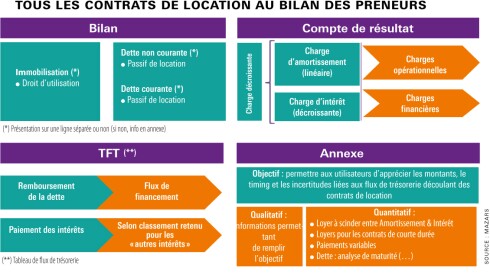
Cette norme comptable met sur « un pied d’égalité » la propriété et la location des locaux d’une entreprise. Sa mise en œuvre interviendra en janvier 2019.
... d’euros. C’est la différence de charges qui pèse sur les entreprises de l’industrie manufacturière française par rapport à leurs homologues allemandes, selon des calculs de COE Rexecode. Les prélèvements obligatoires sont de 66 milliards d’euros en France et de 115 milliards outre-Rhin. Mais rapporté à la taille des secteurs, à leur valeur ajoutée, et corrigé des crédits d’impôts, l’écart est défavorable aux entreprises françaises de 18,4 milliards ou de 7,8 points de valeur ajoutée.
Développements réglementaires ou technologiques et faibles marges imposent aux intermédiaires de la distribution de fonds de gérer d’importants volumes.
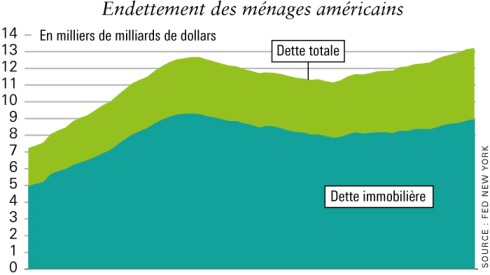
Quinze trimestres d’affilée de progression, insiste le Center for Microeconomic de la Fed de New York chargé de collecter les données de dettes et de crédit des ménages américains, qui profitent au maximum du faible niveau des taux d’intérêt. En ce début 2018, leur endettement atteint un nouveau record historique à 13.210 milliards de dollars, soit 540 milliards de plus que le précédent record du troisième trimestre 2008.
C’est certain. Les Parisiens ont vocation à devenir des banlieusards et à prendre les trains et autres RER dans les années à venir pour se rendre au travail. A peine 775 logements neufs ont été mis en vente l’an dernier à Paris, soit 2,4 % du parc neuf de l’Ile-de-France et ses 31.900 logements, rappelle le Crédit Foncier sur la base d’une étude de l’Adil. On peut parier que ces logements intra-muros ont été achetés par des gens fortunés et rappeler, par la même occasion, que Paris représente 20 % de la population francilienne. Cherchez l’erreur !
Les Libor ont définitivement vécu. La Banque centrale européenne a décidé de dénommer « Ester », pour « euro short-term rate », son taux à court terme en euros qui sera lancé vers 2020. Ester, c’est tout de même plus glamour que Sofr (« secured overnight financing rate »), son homologue lancé par la Fed aux Etats-Unis. Si la Banque de France avait dû créer le sien, on lui aurait suggéré de l’appeler Gigi, parfait pour un taux au jour le jour.
Comme Raymond Aron l’affirma de Giscard, pourra-t-on dire d’Emmanuel Macron que « son drame, c’est qu’il ne sait pas que l’Histoire est tragique ? » Elle ne pourra en tout cas lui reprocher d’avoir sous-estimé les enjeux de l’Europe ni de ne pas les avoir exprimés devant des dirigeants européens aussi sceptiques que leurs opinions publiques. On disait lors de son élection les « planètes alignées » pour un nouvel élan du couple franco-allemand. Paris et Berlin paraissaient partager la même volonté de répondre aux défis de l’irrationalité de la Maison-Blanche, de l’autocratie russe ou de migrations incontrôlées. Mais depuis, si les périls n’ont pas disparu, la foi européenne reste évanescente, éparpillant lesdites planètes aux quatre points cardinaux : l’Allemagne traverse une crise politique profonde, l’est européen cède au nationalisme outrancier, l’Espagne s’enlise dans la crise catalane, et quant à l’Italie, le gouvernement de coalition sur le point de la diriger n’a pour credo commun qu’un euroscepticisme épileptique.
La croissance de l’activité du secteur privé en zone euro a ralenti en mai, pour atteindre son plus bas niveau depuis un an et demi, selon les données préliminaires publiées hier par IHS Markit. L’indice PMI composite de la zone euro s’est établi à 54,1 en mai, contre 55,1 le mois précédent. L’indice était attendu à 54,8 par le consensus. Dans le détail, l’indice PMI du secteur manufacturier est ressorti à 55,5 en mai, un point bas en quinze mois, contre 56,2 en avril, tandis que l’indice PMI du secteur des services s’est établi à 53,9, au plus bas depuis seize mois, contre 54,7 en avril. L’indice PMI manufacturier était attendu à 56 et celui des services à 54,5 en mai.
Le fonds de l’investisseur américain Bill Ackman, Pershing Square Management, a rejoint un autre investisseur activiste dans le capital de Lowe’s en prenant une participation de 1 milliard de dollars (855 millions d’euros) dans la chaîne de magasins de bricolage et de jardinage. Bill Ackman a dévoilé cette participation hier, lors d’une conférence à New York. Lowe’s, dont la capitalisation boursière atteint près de 78 milliards de dollars, est, depuis l’automne dernier, sous la pression de l’investisseur activiste D.E.Shaw, qui détient 1% du capital et qui a obtenu, en début d’année, que le conseil d’administration nomme trois nouveaux administrateurs.
Katia Coudray, la directrice générale de Syz Asset Management, a quitté le groupe suisse. L’information, qui a d’abord été dévoilée par Citywire Selector, a été confirmée par la suite.
Axa apparait comme le leader des assureurs mondiaux pour ses engagements climatiques, selon le classement mondial des assureurs d’Asset Owners Disclosure Project (AODP) publié ce jeudi 24 mai. L’ONG britannique note les efforts en faveur de la limitation du réchauffement climatique des investisseurs institutionnels et s’appuie sur le cadre de reporting du groupe d’experts sur le climat, TCFD (Task Force on Climate Disclosure), émanation du G20. Axa bénéfice de la meilleure note « AAA » notamment grâce à ses annonces faites en décembre : investissements verts portés à 12 milliards d’ici à 2020 contre 3 milliards initialement, désinvestissement des entreprises qui tirent plus de 30% de leurs revenus ou de leur mix énergétique du charbon, fin des assurances des projets de construction de centrale à charbon ni des entreprises d’extraction de sables bitumineux et de pipelines associés. Trois assureurs français dans le top 10 Deux autres assureurs français apparaissent dans le top 10 : CNP Assurances, passé de 76eme à 6eme place, et Crédit Agricole Assurances qui arrive à la 8ème place. Ainsi, la France est le pays qui a le plus d’assureurs notés AAA-B, souligne le rapport. L’Europe est la région leader grâce aux trois meilleurs du classement Axa, Aviva, Allianz. Ce dernier est monté de trois rangs à la 3ème place. 13 des 14 sociétés notées au moins « B » sont européennes. Parmi les 80 assureurs mondiaux, Tokio Marine, Legal & General, Credit Agricole, Allianz SE, Generali, NN Group, et Swiss Re présentent les meilleures progressions sur l’année. Les États-Unis sont en mauvaise position avec 43% d’assureurs notés D ou X malgré les engagements de Hartford, Metlife et Travelers. Mais, même le « meilleur » américain arrive 22eme, The Hartford, noté « CC ». La zone Asie-Pacifique occupe le bas du classement (notes « D » et « X ») sauf le Japon avec 4 sociétés dans le top 20. Dans l’ensemble, le secteur est encore loin d’être aligné sur les objectifs de l’accord de Paris sur le climat, selon le rapport. TV
Nordic Capital today announced the final close of Nordic Capital Fund IX, at just over EUR 4.3 bn. The oversubscribed Fund exceeded its EUR 3.5 bn target in 7 months, and due to strong demand closing 23% above target.The new Fund enjoyed a re-up rate of over 70% from investors in predecessor funds, while also attracting commitments from a number of new investors. LP commitments represented a well-diversified institutional mix with Fund IX investors including public and private pension funds (c. 35%), sovereign wealth funds (c. 20%), fund of funds (c. 15%), family offices (c.15%), financial institutions and endowments (c. 15%). The Fund benefited from broad geographic support, expanding its well established investor base in North America (c. 40%), Europe (c. 35%) and Asia (c. 15%), and attracting new investors in the Middle East and South America (c. 10%).Consistent with the strategy of its predecessor fund, a top quartile performer, Fund IX will focus on five core sectors: Healthcare; Financial Services; Technology and Payments; Consumer Retail and Industrial Goods and Services. The Nordic region, which continues to be a highly successful and stable incubator of high quality businesses, will be central to the deployment of the new Fund, as will investing selectively in European businesses and in global Healthcare. Moreover, Fund IX will also continue Nordic Capital’s active co-investment strategy.
Fidelity International has announced that its variable fee model is now available for five equity funds of its Luxembourg SICAV. Since yesterday, investors are able to invest in a “clean share class” with no commissions, applying the management fee-free model of its Fidelity Funds America Fund, Fidelity Funds Emerging Markets Focus Fund, Fidelity Funds European Growth Fund, Fidelity Funds European Larger Companies Fund and Fidelity Funds World Fund.The new share classes will make it possible to invest with reduced annual management fees of 0.10%, for a total of 0.70%. The variable part of the fees will then symmetrically adjust up or down depending on the performance of the fund compared to its benchmark index. This value will be determined on a three-year annualised basis, exempt of all fees and charges. This scale will go up to a maximum of +0.2% over the annual management fees, and a minimum of -0.2% below, which will mean that the maximal and minimal fees charged would be 0.90% and 0.50%, respectively.“We have listened and responded to the growing debate about the value of active fund management. Our model of variable management fees clearly aligns our interests with those of our clients, and, contrary to the practice common in the market, our fees will be affected in case of under-performance. This is a major step to demonstrate our ongoing commitment to offer the best possible value to our clients. We are convinced that this is an important step in the future of active management, and we hope that it will incite client to remain invested for the long term,” says Paras Anand, director of equity investments for Europe, in a statement.Clients investing via dedicated portfolios, particularly institutional investors, will have access to an appropriate version of the cost model they desire. The value of investments and income resulting can rise or fall, and clients may not recover all of the amount initially invested, the statement warns.
@page { margin: 0.79in }p { margin-bottom: 0.1in; line-height: 115% }Italian PIRindividual savings plans completed first quarter 2018 with netinflows of EUR2bn, less than the EUR3.4bn posted in the last threemonths of 2017, according to the most recent statistics fromAssogestioni, the Italian association of asset managementprofessionals. Overall, the Italian asset management sector completedfirst quarter with inflows of EUR13.9bn, also down compared withEUR17bn as of the end of December last year.The decline in PIRinflows has affected all product categories, but has beenparticularly significant for equity products, with inflows down fromEUR876m to EUR193m.Assets in PIR fundshave increased, however, to EUR17.5bn, with 41.9% in diversifiedproducts, 31.2% in e1uity products, 25.7% in flexible products, andthe rest in bond products.
The venture capital firm BC Partners on 22 May announced that it is creating BC Partners Real Estate, a new real estate platform. To this end, Stéphane Theuriau, previously chairman and CEO of Altarea Cogedim, a French real estate investment company, has been appointed as managing partner in London, responsible for constructing and directing the new strategy. Theuriau joined BC Partners at the start of May, after a 25-year career in the pan-European real estate market. Before joining Altarea Cogedim in 2009, je launched the real estate investment platform at Morgan Stanley in France in 1998, and became head for Europe from 2003 to 2006.In his new role at BC Partners, Theuriau will work to create a new team, which will “continue its pan-European opportunistic strategy, covering all sectors in real estate, making direct and indirect investments in private equity as well as investments in controlling and minority stakes,” the private equity firm says in a statement. The platform from BC Partners Real Estate will be fully integrated into BC Partners, and “will be based on the profound knowledge and expertise of the company, and will use its infrastructure.” The new real estate platform comes in addition to the private equity investment activities of BC Partners, which have closed the flagship fund BC European Capital X with EUR7bn, and the opportunistic credit platform, BC Partners Crédit, launched in February 2017.
Marie-Pierre Peillon, current head of research at Groupama Asset Management (Groupama AM), has been appointed as head of ESG research and strategy. In her new role, Peillon will be responsible for ESG strategy at Groupama AM throughout its components. This comes in addition to her current responsibilities as head of research.Aurélie de Barochez is also appointed as head of ESG integration. De Barochez will report to Peillon, and will steer transversal integration of ESG analytical criteria throughout all management and design of resources and processes to permit deployment. De Barochez joined Groupama AM in 2015, as a financial and extra-financial analyst, responsible for the energy sector and the environment. She contributed to the development of the team of financial analysts into a global financial/extra-financial integration unit.“Groupama AM very soon, from 2003, cultivated recognised expertise in the market in extra-financial analysis. Our collective project as a business is to gradually deploy a global and transversal ESG approach to our range of solutions and services,” says Philippe Setbon, CEO of Groupama AM.
@page { margin: 0.79in }p { margin-bottom: 0.1in; line-height: 115% }The private bank of Edmond de Rothschild (France) has appointed Maxime Agache as headof development of activities for the Nord region of France. He isalso a member of the board of directors for the private bank inFrance.Agache joined Edmondde Rothschild (France) as a private banker in 2014. He had previouslybeen director of a corporate business centre at Crédit Agricole Nordde France, after serving for four years as representative for largebusinesses.“Teams in Lille,reporting to … Agache, will help to accelerate development of theproduct range from Edmond de Rotschild in the Nord region, combiningexpertise in wealth management and assistance from family companyshareholder directors, for all family and corporate themes,” astatement says.
The SCPI Pierre 48 fund, managed by Paref Gestion, has acquired a group of 10 jointly-owned residential units in Levallois-Perret (92), the asset management firm announced on 22 May. The properties acquired, for a total of EUR5.2m in hand, are acquired at a discount of 40%, for a provisional internal rate of return of 3% per year over the life of the 14-year break-up, “excluding re-evaluation related to structural ad conjuncutral changes in the residential real estate market,” says Paref Gestion. The group of 10 apartments is located in the “Levallois Parc” residence.
Ekim, a French food tech start-up founded in late 2013, has announced its first institutional fundraising for EUR2.2m, with the investment funds Partech and Daphni. Jérôme Taf-ani, CEO of Quick and Burger King France, joins the strategy board at Ekim. Ekim, imagined by two young French engineers, Sébastien Roverso and Cyrill Hamon, and led by Philippe Goldman, formerly of L’Oréal, Ekim plans to revolutionise global food tech, and has announced the creation of the first 100% automated restaurant with robots preparing the pizzas in front of the client, a statement explains.
The Autorité des Marchés Financiers (AMF) appointed Domitille Dessertine as head of its FinTech, Innovation and Competitiveness division. Member of the Regulatory Policy and International Affairs Directorate (DRAI) for the past five years, Domitille Dessertine participated in the creation of the Fintech, Innovation and Competitiveness (FIC) division in May 2016. She has been appointed head of the division, succeeding Franck Guiader, who left the AMF after seven years dedicated to financial regulation, innovation and competitiveness. Domitille Dessertine joined the Autorité des Marchés Financiers in July 2013 as a policy officer at the DRAI in the Asset Management Division. She participated in European and international negotiations on subjects relating to asset management. In this capacity, she was particularly involved in the European money market fund reform project, which will enter into force on 21 July 2018. She was also a member of the working group initiated by the Financial Stability Board on shadow banking.From spring 2016, she contributed to the creation of the French Fintech, Innovation and Competitiveness team, in charge of supporting innovative companies and reflecting on potential changes to the regulatory framework to adapt to the increasing digitalisation of financial services. Domitille thus took part in the launch of the AMF’s consultation on the framework for Initial Coin Offerings (ICO) and in the analysis of the responses received, as well as the rollout of the Unicorn programme, which resulted in some 50 meetings with ICO project holders. She also contributed to the AMF’s response to the European Commission’s public consultation on Fintechs.Domitille holds a degree from the Institut d’Etudes Politiques de Paris and is finishing a PhD in finance from the Université Paris I Panthéon-Sorbonne. She started her career in July 2011 at the International Organisation of Securities Commissions (IOSCO) where she was involved in several post-crisis financial regulation initiatives, including the work carried out on the identification of systemic entities and on the regulation of over-the-counter traded derivatives.
The US assetmanagement firm VanEck is extending its offerings in Italy with thelaunch of five ETFs on the Milan stock exchange, Funds People Italiareports. The new funds are the following: VanEck Vectors GlobalFallen Angel High Yield Bond UCITS ETF, VanEck Vectors EmergingMarkets High Yield Bond UCITS ETF, VanEck Vectors Natural ResourcesUCITS ETF, VanEck Vectors Preferred US Equity UCITS ETF and VanEckVectors Global Mining UCITS ETF. @page { margin: 0.79in }p { margin-bottom: 0.1in; line-height: 115% }