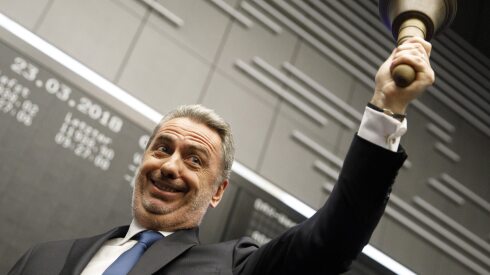
Nicolas Moreau a le sourire. Le patron des activités de gestion d’actifs chez Deutsche Bank a réussi la mise en Bourse de DWS, avec un an d’avance sur la date limite que s’était fixée la banque allemande. Le Français a d’autant plus de raisons d’être satisfait que le processus n’a pas été une promenade de santé, dans un marché devenu plus volatil ces dernières semaines. Mais l’action DWS a fini sa première séance légèrement dans le vert le 23 mars, pile au milieu de la fourchette de prix visée initialement. Avec une capitalisation boursière de 6,5 milliards d’euros et sa propre marque, le gérant pourra désormais se mesurer plus librement à ses grands concurrents européens.
L’investissement responsable, quelle gageure ! En témoignent les dernières nouvelles en provenance du géant CalPers. Dans le cadre de sa politique d’engagement 2018, le fonds de pension de la fonction publique californienne se targue d’agir pour obtenir davantage de présence féminine au sein des conseils d’administration. Il met en outre l’accent sur son souhait de voir les entreprises mieux témoigner de leurs efforts relatifs à la lutte contre le changement climatique. Las, une décision du comité d’investissement de CalPers fait tache. Il vient de refuser d’engager le fonds dans le désinvestissement des grossistes et détaillants d’armes d’assaut, plaidant que cela n’aurait pas d’effet sur la violence ambiante. CalPers évite déjà depuis 2012 les fabricants d’armes, mais n’ira pas plus loin. Pour l’instant.
Bizarrerie. Plus le Brexit devient réalité et plus le nombre d’investisseurs anticipant qu’il n’aura pas lieu augmente. Ils sont 15 %, sur les 974 professionnels sondés par le Chartered Financial Analyst Institute, à considérer qu’il n’aura pas lieu. Les incrédules ne représentaient que 5 % du panel en 2017. Bon, ils sont tout de même plus des deux tiers à prévoir un déménagement de tout ou partie de leurs activités. Mais quand même… Il n’y a pas pire sourd que celui qui ne veut pas entendre.
C’est le nombre d’affaires introduites l’an dernier auprès de la Cour de justice (739, nouveau record) et du Tribunal (917) de l’Union européenne. Quant au nombre d’affaires clôturées, il a atteint 1.594. Les affaires dites pendantes sont, elles, au nombre de 2.410. Quelques centaines de plus que les années précédentes. Ce qui n’empêche pas la durée des moyennes des procédures de se réduire sans cesse : 16,3 mois, une réduction de 40 % en cinq ans.
Section 301. Après les mesures tarifaires sur l’acier et l’aluminium annoncées le 8 du mois et pour lesquelles l’Union européenne sera temporairement exemptée, ce sont 60 milliards de dollars d’importations chinoises qui ont été visées le 22 mars par l’administration Trump en représailles d’accusations de violations de la propriété intellectuelle (des poursuites devant l’Organisation mondiale du Commerce sont prévues). Le tout en vertu de la section 301 de la loi sur le Commerce de 1974. La Maison-Blanche avait lancé il y a peu un banc d’essai en instaurant des taxes sur les importations de panneaux solaires et de machines à laver. Les statistiques chinoises montrent que les Etats-Unis sont le seul pays à avoir enregistré une hausse des importations chinoises en 2017. Un déficit commercial total de 810 milliards de dollars a été relevé l’an dernier aux Etats-Unis intégrant un déficit bilatéral de 375 milliards avec la Chine (505 milliards d’importations pour 130 milliards d’exportations, L’Agefi Hebdo du 15 février 2018). Des mesures de rétorsion de la part de la Chine porteront sur 128 produits américains qui subiront des droits de douane de 15 % ou 25 %. Les principaux postes d’exportation des entreprises américaines vers la Chine sont l’aéronautique civile, le soja et l’automobile. Pour les analystes d’UniCredit, les entreprises américaines seront pénalisées de trois façons : en tant qu’importateurs de biens intermédiaires et fournisseurs des entreprises chinoises, par une appréciation du dollar et par les mesures de rétorsion. Selon Oxford Economics, une taxe de 25 % sur 60 milliards d’importations chinoises amputerait de 0,1 point de pourcentage la croissance du PIB. Oxford Economics indique que 2,6 millions d’emplois dépendent directement des relations commerciales Etats-Unis-Chine. Pour rappel, la Chine détient 1.100 milliards de dollars de Treasuries, soit 8 % du stock de titres d’Etat américains.
On connaissait les ronds-points multipliés à l’envi dans certaines communes car financés par la Commission européenne. Voici le « Wifi pour tous » et 120 millions d’euros de subventions européennes accordées à 8.000 communes et territoires où la connectivité est rare. Il s’agit de « corriger certaines fragilités de la ruralité », selon la commission des Affaires européennes du Sénat. Les jardins publics des villages concernés pourront disposer d’une connexion sans fil et gratuite financés jusqu’à 15.000 euros par l’Europe. Pas sûr que cela adoucisse les « c’est de la faute à l’Europe ».
UBS a entamé l’unification de ses structures de gestion de fortune en regroupant les équipes responsables des produits de banque privée. Le groupe financier suisse avait annoncé en janvier qu’il allait rapprocher ses activités destinées au marché américain et à sa clientèle internationale en une seule division mondiale. A l’heure actuelle, l’évolution concerne les équipes locales responsables pour la gestion des produits et services liés aux investissement alternatifs, aux mandats et aux partenariats, indique une note interne obtenue par Reuters et confirmée par UBS.
«Nous avons besoin d’expertises pointues que nous ne possédons pas toujours en interne pour développer [une] gestion thématique de long terme», a expliqué à Option Finance Olivier Héreil, directeur général adjoint de BNP Paribas Cardif. «Nous avons pas exemple récemment sélectionné un fonds de Mirova, dont le but consiste à ne pas dégrader les terres cultivées». D’autres institutionnels comme Fondaction, Fondation de France, et Garance se sont mobilisés à côté de l’assureur pour investir dans le fonds LDN (Land Degradation Neutrality) de Mirova. Les engagements totaux s’élèvent à plus de 100 millions de dollars sur un objectif 300 millions. Cet investissement répond pour BNP Paribas Cardif à un objectif plus large : «Nous considérons que nous avons vocation à avoir un impact positif sur la société en sélectionnant des titres ou des fonds qui ont un rôle social ou qui permettent de lutter contre le réchauffement climatique», a souligné Olivier Héreil. De fait, l’institution a annoncé en décembre dernier son souhait de doubler ses investissements verts à horizon 2020.
Total Energy Ventures (“TEV,”) the investment fund from the Total group for energy startups, Hubei High Technology Guiding Fund Management Co., Ltd., (“Hubei High Tech,”) the invesment platform for the province of Hubei, and Cathay Capital on 27 March announced that they have signed an agreement to launch the Cathay Smart Energy Fund, an investment fund dedicated to the energy sector in China.The fund will concentrate investment on emerging technologies and new business models in the energy sector in China, including renewable energy, the Internet of energy, energy storage, decentralised energy, smart energy and low-carbon activities. This will allow Total to explore new technological opportunities in China, and to identify new business models and new technologies. TEV and Hubei High Tech will supply CNY300m (USD50m) each. At the conclusion of the first round, other partners will join the fund, with a final capital objective to exceed CNY1.5bn (about USD250m).“China is at the cutting edge of energy technologies in the 21st century. Through this investment, we are enthusiastic about teaming up with the innovation ecosystem in the energy sector in China, thanks to the knowledge of the Chinese market which Cathay Capital brings us. We think that it represents strong potential for innovation and growth in areas related to new energies and sustainable development, and resounds with an ambition at Total to become a major player in responsible energy,” says Patrick Pouyanné, chairman and CEO of Total, in a statement.Cathay Capital Private Equity manages eight investment vehicles with total assets under management of over EUR2bn.
@page { margin: 0.79in }p { margin-bottom: 0.1in; line-height: 115% }InvescoAsset Management (Invesco) on 27 March announced that it hasappointed Laurent Vitel-Lepinay as its head of regulatory affairs forEurope, the Middle East and Africa (EMEA). In this new role, he isresponsible for overseeing regulatory changes in the EMEA region, andcoordination of implementation throughout the Invesco group.Vitel-Lepinay,36, began his career in 2004 at Invesco Asset Management S.A., wherehe served in a variety of roles in the legal department, and mostrecently had served as senior lawyer responsible for legal supportfor distribution activities for Luxembourg and Irish funds. In 2016,he was also appointed as deputy CEO of Invesco Asset Management S.A.
The proportion of FCPE money market funds as a percentage of employee savings funds contnued to fall last year, according to the initial results of the 2018 edition of the “Argus of enterprise common investment fund” (“Argus des Fonds Communs de lacement d’Entreprise») study by Eres. Assets in money market FCPE funds declined by EUR3bn compared wit 2016, with payments of EUR500m.The study finds that last year, 100% of savings investors lost money on money market FCPE funds, whose performance continued to deteriorate. The average performance for money market FCPE funds (evolution of net asset value from 01/01/2017 until 31/12/2017) fell to -0.35%, compared with 0.17% the previous year. 100% of money market FCPE funds posted negative returns in 2017.“As our study finds, money market funds no longer gain anything. They even lose money for their shareholders by delivering negative returns. Due to actions on the part of various market actors to raise awareness, companies and savings investoprs are aware of this economic reality and are preferring other investments (equities, bonds, diversified funds) to the detriment of money market investments. Some companies have even replaced money market funds with bond funds in their frameworks,” says Nicolas Vachon, chairman of Eres Gestion.
@page { margin: 0.79in }p { margin-bottom: 0.1in; line-height: 115% }TheFrench investment consulting firm Cedrus Partners will open an officein Madrid, Spain, in July, Christel Bapt, its chairman, has toldNewsManagers, confirming reports in InvestmentEurope. The newstructure will target Spanish family offices, associations andfoundations.Meanwhile,the firm will also be opening a third office in France, in Lyon, inApril, as an addition to its locations in Paris and Bordeaux. TheLyon office will be led by Clément Joly, who had previously servedat ABN Amro Bank in Hong Kong, the firm has announced. CedrusPartners now has over EUR17bn in assets advised.
@page { margin: 0.79in }p { margin-bottom: 0.1in; line-height: 115% }UnionInvestment has announced that it is acquiring an office property inParis from Commerz Real. The Euro Alsace building is located in the10thdistrict of Paris, near the Gare de l’Est. The fund, which since2007 had been part of the closed fund CFB 165 from Commerz Real, willbe integrated in to the open institutional fund UniInstitutionalEuropean Real Estate, a statement says. The sale price has not beendisclosed.Withthis new acquisition, Union Investment has 15 properties undermanagement in Paris, representing a value of about EUR2.6bn.
@page { margin: 0.79in }p { margin-bottom: 0.1in; line-height: 115% }TheNetherlands-based Akzo Nobel group on 27 March announced that it hassold 100% of its “Specially Chemicals” activity to the investmentfirm Carlyle and the Singapore sovereign fund GIC, for a total ofEUR10.1bn. The transaction is expected to be completed by the end ofthe year, a statement says. Proceeds from the sale are expected tototal EUR7.5bn, most of which will go to shareholders.Refinedchemical activities represent one third of earnings and profits atAkzo Nobel. The group, which had been seeking to sell off or hold aninitial public offering for the division, ultimately found that asale was in the better interests of everyone, particularly since“Carlyle has long experience in the chemical industry, and hasproven itself in the area of health, safety, innovation andsustainable development,” the CEO of Akzo Nobel, ThierryVanlancker, says in a statement.
@page { margin: 0.79in }p { margin-bottom: 0.1in; line-height: 115% }Theportfolio manager Ian Kelly, who had managed the Schroder ISF GlobalDividend Maximiser fund (USD4bn in assets) has left Schroders, after11 years at the asset management firm, the specialist websiteInvestment Week reports. A spokesperson for Schroders has confirmedthe reports and announced that Kelly wanted to give a new directionto his career, outside Schroders. Simon Adler and Nick Kirrage willtake over co-management of several funds managed by Kelly, includingthe Schroder Global Equity Income Fund, Schroders ISF Global EquityYield Fund and the Schroder ISF Global Dividend Maximiser Fund. Theinvestment objectives and management processes of these funds are notchanged, a spokesperson says.Kellyjoined the European equity research team at Schroders in 2007. Hethen joined the value team in 2010.
The Swiss federal financial market authority (Autorité fédérale de surveillance des marchés financiers, FINMA) on 27 March drew attention to rising risks related to cybercrime. The risk of cyberattacks has been growing in parallel with progress in digitization, a statement says. “Cyberattacks have become the main operating risk to the financial system,” said Mark Branson, director of FINMA, at an annual press conference. FINMA has made targeted additions to its knowledge in this area. Branson has called for an intensificatino of dialogue between disciplines concerning cyber-risks, both in the public sector and with other actors in the field.Long before it was found in 2017 to have contributed to cases of market manipulation and insider trading operations, and for money laundering, FINMA has stated that the “great majority of financial institutions” are operating and functioning correctly. The few establishments in exception are damaging the reputation of the Swiss financial marketplace, FINMA said on Tuesday in a statement at its annual press conference.
@page { margin: 0.79in }p { margin-bottom: 0.1in; line-height: 115% }TheMirabaud group on Tuesday announced an increase in its net profits of28% in the 2017 fiscal year, to CHF40.5m.Assetsunder administration are up 11% compared with 31 December 2016, toCHF33.3bn, “thanks to the markets and net inflows,” a statementsays. Total net assets came to CHF31.2bn as of 30 June 2017.Ofthis total, CHF9bn are managed by Asset Management, and CHF24.3bn byWealth Management.Earingsare up to CHF305.3m (CHF289.0m in 2016), with commissions ofCHF237.3m, results from trading operations of CHF33.3m, and interestfor CHF27.8m. Operating costs, excluding amortisation and tax, totalCHF247.2m (compared with CHF244.4m in 2016), in a sign of continuedcost controlling.Totalconsolidated balance sheet totals CHF4.194bn. This consists largelyof deposits for liability-driven investment clients. Two thirds ofassets are placed with the Swiss national bank or are invested inshort-term money market papers from governments, in the best ratingscategories. The group has a Tier 1 common equity ratio of 21%, and aliquidity coverage ratio of 202%.
La société de gestion indépendante Capzanine, spécialisée dans l’investissement privé, a annoncé ce 27 mars la nomination de Clément Colin en tant que directeur de participations et d’Emmanuel Fournial en tant que chargé d’affaires. « L’entreprise compte désormais 34 collaborateurs répartis en France, en Allemagne, en Espagne et prochainement en Italie, indique Laurent Bénard, directeur général de la société, cité dans un communiqué. Capzanine a réalisé 12 recrutements en 2017 ».Clément Colin a débuté son parcours professionnel en 2013 en tant qu’analyste chez Duke Street. Il a ensuite rejoint Capzanine en tant que chargé d’affaires. Pour sa part, Emmanuel Fournial a débuté son parcours professionnel en 2015 en tant que chargé d’affaires chez Capzanine.
Hicham El Aissaoui, jusque-là gérant de portefeuille chez Athymis Gestion, a quitté la société de gestion présidée par Stéphane Toullieux, a appris InvestmentEurope. L’intéressé travaillait au sein de la société depuis février 2013. Il a notamment été le gérant principal du fonds Athymis Millenial, lancé en juin 2016, et il a co-géré les fonds Athymis Better Life, Athymis Patrimoine et Athymis Alternatifs.En parallèle, toujours selon InvestmentEurope, Claire Bruhin a rejoint Athymis Gestion en mars en tant que gérante de portefeuille. Elle travaillait précédemment en tant qu’analyste de fonds chez CNP Assurances.
Blackstone, via son entité Strategic Capital Holdings Funds, vient de faire l’acquisition d’une participation minoritaire au capital de PAG, une société de gestion alternative asiatique, a annoncé ce 26 mars le gestionnaire d’actifs alternatifs américain. Strategic Capital Holdings Fund fait partie de Blackstone Alternative Asset Management et est spécialisée dans la prise de participation minoritaire dans des gestionnaires d’actifs alternatifs. Basée à Hong Kong, PAG affiche plus de 20 milliards de dollars de capitaux sous gestion répartis dans des stratégies de capital-investissement, immobilière et d’absolute return. Les détails de l’opération n’ont pas été dévoilés.
La société d’investissement Ardian a dévoilé, hier, le recrutement de Mark Voccola au sein de son bureau de New York en qualité de « managing director » chez Ardian Infrastructure. L’intéressé a officiellement rejoint la société en août 2018, précise Ardian dans un communiqué. Dans le cadre de ses fonctions, il partagera la responsabilité des activités d’infrastructures US d’Ardian avec Stefano Mion, « managing director » et co-responsable d’Ardian Infrastructure US. Mark Voccola fera également partie de l’équipe global d’Ardian Infrastructure qui compte désormais 30 professionnels de l’investissement. « Mark Voccola jouera un rôle majeur dans l’élaboration de la vision et de la stratégie d’Ardian sur le continent américain », précise la société. Il sera notamment « chargé d’étudier les opportunités d’investissement et travaillera aux côtés des partenaires industriels de longue date d’Ardian afin d’identifier les meilleurs actifs d’infrastructures essentielles en Amérique », poursuit Ardian.Précédemment, Mark Voccola occupait le poste de « Partner » chez Ares EIF au sein d’Ares Private Equity Group, où il était chargé d’étudier les opportunités d’investissements et de surveiller l’évolution des sociétés en portefeuille. Avant de rejoindre Ares en 2015, il a été « Partner » chez Energy Investors Funds (EIF).
Jean-François Bay vient de quitter La Financière de l’Echiquier où il était directeur de la stratégie, du développement et de l’international depuis moins d’un an, a appris NewsManagers. L’information a été confirmée par une porte-parole de la société de gestion, qui précise qu’il s’agit d’un « choix personnel ». Christophe Mianné, le directeur général de La Financière de l’Echiquier et directeur général délégué du groupe Primonial en charge de l’asset management financier, va assurer l’intérim. Mais pour le moment, la recherche d’un successeur n’est pas à l’ordre du jour.Jean-François Bay avait rejoint La Financière de l’Echiquier en mai 2017, après avoir été directeur général de Morningstar France. Il avait pour mission de bâtir un plan stratégique visant à renforcer la présence de La Financière de l’Echiquier auprès de ses réseaux de clients, en France et à l’international, conseillers en gestion de patrimoine, investisseurs institutionnels, banques privées et family offices.Quelques mois plus tard, en novembre, La Financière de l’Echiquier annonçait un partenariat avec Primonial, qui a vu La Financière de l’Echiquier acquérir le 28 février 100 % des activités asset management financier de Primonial, tandis que ce dernier a pris une participation de 40 % du nouveau périmètre La Financière de l’Echiquier.