C’est une des mesures de représailles à la guerre tarifaire lancée par l’administration Trump contre les importations chinoises aux Etats-Unis. Les exportations américaines de porcs vers la Chine ont chuté. Les autorités chinoises se sont tournées vers la Russie pour s’alimenter en viande de porc. Sans doute moins regardant sur les contrôles sanitaires de la gent porcine, Moscou a exporté des individus grippés. Le quart de la population mondiale de porcs serait régulièrement infecté, mais comme le taux de mortalité de la grippe porcine est faible, les gorets chinois sont contaminés en masse. Du moment que ce n’est pas au Novichok.
… de dollars. C’est le montant au 24 septembre de l’encours obligataire mondial dont le rendement est négatif. Le retour en zone positive est rapide. A son sommet en juin 2016, la valeur de marché du stock à taux négatifs était de 12.100 milliards, rappelle Legg Mason. En mars 2010, avant la généralisation des achats d’actifs par les banques centrales, il était de 425 milliards. En dix ans, les taux négatifs sont passés du statut de curiosité intellectuelle et théorique à celui de déterminant majeur des marchés obligataires et des actifs sans risque.
La dette publique de la France franchira-t-elle le seuil des 100 % du PIB ? La dimension symbolique de ce seuil n’échappe à personne, même si les acheteurs d’OAT s’en contrefichent. L’art de la statistique ou plus crûment le bidouillage des séries étant ce qu’il est, la France a en réalité franchi ce seuil en 2017 (vous ne le saviez pas !) avant de repasser dessous : 100,7 % et 100,9 % pour les deux premiers trimestres de 2017… et 99 % au printemps dernier, nous dit l’Insee. Pas grave, l’essentiel est de savoir que la Sécurité sociale a supporté tout l’effort : -20 milliards (de 232 à 212 milliards) en un an. Quant aux autres administrations…
Substitution. Le Nafta (Alena), l’accord de libre-échange nord-américain créé en 1994, laisse la place à l’USMCA (AEUMC), l’«Accord Etats-Unis-Mexique-Canada ». Ce nouvel accord tripartite a été signé in extremis le 30 septembre, quelques minutes avant l’ultimatum fixé par les Etats-Unis. Les agriculteurs américains auront accès à 3,5 % du marché laitier canadien, estimé à 16 milliards de dollars. Une bonne nouvelle, à quelques semaines des élections mid term, pour l’agriculture des Etats-Unis affectée par le conflit tarifaire avec la Chine sur les exportations de soja. Le Canada et le Mexique pourront exporter, chacun, 2,6 millions d’automobiles chez leur voisin, des niveaux supérieurs aux volumes d’exportations actuels. En revanche, les tarifs sur les exportations canadiennes d’acier et d’aluminium n’ont pas trouvé de solution. L’ensemble des trois pays représente une zone d’échanges commerciaux de 1.200 milliards de dollars.
Surchauffe. Le rapport UBS Global Real Estate Bubble Index 2018 d’UBS Global Wealth Management s’est penché sur le risque de bulle des marchés du résidentiel dans les principaux centres financiers. En tête, Hong Kong, Munich, Toronto, Vancouver, Amsterdam et Londres. D’importants déséquilibres sont aussi manifestes à Stockholm, Paris ou Francfort. Les valorisations sont élevées à Zurich et Genève, ainsi qu’à Los Angeles, Tokyo et New York. A l’inverse, les marchés immobiliers semblent être à leur juste valeur à Boston, Singapour et Milan, voire sous-évalués à Chicago. Paris connaît les prix les plus prohibitifs d’Europe continentale. Pour acheter un logement de 60 m², un salarié qualifié dans le secteur tertiaire doit y consacrer 14 ans de salaire. UBS estime improbable la poursuite de la hausse des prix à ce rythme. Le rapport prix/revenu médian des villes analysées a progressé de 5,5 en 2008 à 7,5 en 2018. Comme le logement devenait inabordable au cours des cinq dernières années, presque toutes les villes devenues trop chères ont introduit de nouvelles règles, comme l’imposition de droits de timbre ou un contrôle des loyers.
Reconnaissance. Après MSCI en mai dernier (première vague) puis cet été (seconde vague), c’est au tour de FTSE Russell d’inclure les A-shares chinoises dans ses indices mondiaux. Le fournisseur d’indices envisage de porter leur pondération dans ses indices clé à 20 %. Cette intégration se déroulera en trois phases entre juin 2019 et mars 2020. FTSE Russell a confirmé que les actions chinoises A allaient être promues au statut de marché émergent secondaire suite à la révision annuelle de sa classification pays menée en septembre et pour sa gamme FTSE Global Equity Index Series (FTSE GEIS). Après la fin de la première phase, les actions chinoises A constitueront environ 5,5 % du total de l’indice FTSE Emerging, contre 0,57 % pour le FTSE Global All Cap Index. La Chine sera ajoutée à sa liste de surveillance pour une possible inclusion dans ses indices obligataires mondiaux.
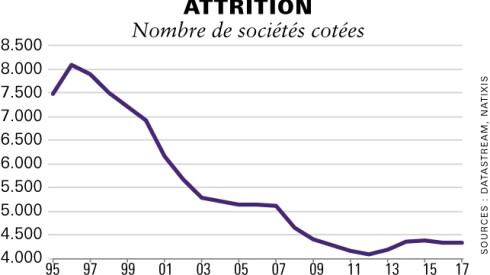
Dilution. Lentement mais sûrement, le nombre de sociétés cotées aux Etats-Unis diminue. De plus de 8.000 dans la seconde moitié des années 1990, il est passé à moins de 4.500. Les sorties de la cote ont accompagné le vaste mouvement de rachats d’actions qui doit atteindre cette année le niveau record de 1.000 milliards de dollars, indique une étude de Natixis. Ce processus risque de faire disparaître le rôle du marché actions comme source de financement de l’économie et de mesure de la valeur des entreprises, indique la note. Autre conclusion, ce processus implique que les Etats-Unis évoluent vers un modèle d’entreprises non cotées (private equity…), à la place du modèle d’entreprises cotées.
C’est le taux de croissance pour 2017 des actifs investis en microfinance, selon le 2018 Symbiotics MIV Survey, qui montre que les fonds apportés par les investisseurs institutionnels privés augmentent de 27 %, les fonds publics de 17 % et les fonds apportés par les investisseurs particuliers et à hauts revenus de 16 %. Ces sommes ont financé des prêts à 655.000 emprunteurs, surtout des femmes (69 %), et en zone rurale (55 %). Le montant du prêt moyen s’élève à 2.432 dollars.
Dans sa croisade pour davantage de transparence, la Securities and Exchange Commission (SEC), qui vient de proposer la suppression de l’intraday net asset value qui permet aux investisseurs de comparer le prix d’un fonds par rapport à la valeur de ses sous-jacents toutes les 15 secondes, se penche désormais sur la fourchette bid/ask. Cet écart détermine la liquidité, donc le coût, d’un ETF (exchange-traded fund). La SEC insiste pour que cette donnée soit communiquée aux investisseurs sur l’exercice le plus récent pour une meilleure comparaison entre les produits. BlackRock et State Street contestent la méthode…
L’Association Française de la Gestion financière (AFG) et l’Association française des investisseurs institutionnels (AF2I) ont réalisé une nouvelle série commune de questionnaires standards, destinés à améliorer la connaissance que peuvent avoir les investisseurs des sociétés de gestion de portefeuille (SGP) et de leurs offres, ont-elles annoncé par communiqué hier. Ces nouveaux questionnaires standards mis à disposition des clients (institutionnels ou sélectionneurs de fonds), dans le cadre de procédures de due diligence, ont été élaborés avec plus d’une vingtaine de sociétés de la Place de Paris. Ils ont été soumis le 2 octobre aux SGP et aux investisseurs. Le premier questionnaire vise à présenter la société de gestion, le deuxième détaille les caractéristiques du fonds d’investissement ouvert proposé, le troisième comporte des informations spécifiques en cas d’appel d’offres. Ces documents intègrent désormais de nouveaux aspects tels que les nouvelles contraintes réglementaires ou les problématiques liées à l’investissement socialement responsable.
La Caisse d’Amortissement de la Dette Sociale (Cades) a amorti 146,6 milliards d’euros de dette au 30 juin 2018, soit 56% de la dette sociale reprise depuis 1996. Sur 260,5 milliards d’euros repris, il reste désormais 113,9 milliards d’euros de dette à amortir. Les ressources de la Cades s’établissent à 8 milliards d’euros, le montant des intérêts est de 1,1 milliard d’euros. Depuis le début de l’année, la Cades a levé 2,6 milliards d’euros de dettes à moyen et long-terme sur les marchés des capitaux. Le taux de refinancement sur le portefeuille de dettes de la Cades s’établissait au 30 septembre à 1,97%. Depuis le 1er octobre 2017, une convention de gestion et une convention cadre de mise à disposition des personnels ont été mises en œuvre entre la Cades et l’AFT.
Le gérant d’actifs serait en pole position pour empocher le contrat et pourrait offrir en échange une participation dans le gérant de fortune Cazenove.
Steven Maijoor, président de l’Esma, l’autorité de supervision européenne des marchés financiers, a appelé hier dans un discours à Athènes à «une conclusion rapide du dossier législatif Emir 2.2» dans la perspective du Brexit. En l’absence de ce texte, une sortie brusque du Royaume-Uni de l’Union européenne fin mars 2019 entraînerait la perte d’accès des institutions financières européennes aux chambres de compensation (CCP) britanniques. Or, «40% du trading d’actions européennes sur les marchés secondaires s’effectuent sur les places de marché britanniques», a-t-il souligné.Il a aussi évoqué la nécessité d’adapter les seuils quantitatifs de MIF 2, conçus alors que le Royaume-Uni était partie intégrante de l’Union européenne.
Dans la foulée du scandale Danske Bank, la banque centrale estonienne a indiqué mercredi qu’entre 2008 et 2017, environ 1.100 milliards d’euros de flux transfrontaliers avaient transité par le pays. Ces mouvements, dont la banque centrale ne dit pas s’ils revêtent un caractère suspect, représentent environ 50 fois le produit intérieur brut du pays. Ces flux «cross-border» concernent à la fois des résidents et des non-résidents, les chiffres spécifiques à ces derniers n'étant pas disponibles.
Finnish financial group S-Bank (S-Pankki) and its asset management arm FIM have launched the first green bond fund available in Finland on 1 October 2018. The FIM IG Green ESG fund invests in green bonds issued by companies that are renowned for their ability to invest in a sustainable way. Among others, FIM uses research from MSCI ESG Research to assess how green the issuers are. MSCI’s set of criteria require from green bond issuers that 90% of the financing will support projects contributing to a better environment. «Green bonds are a very efficient way to exploit financial markets in order to support environmental projects. Conviviality and environmental sustainability are ever more considered as important for competition and seen as a key to success."Green bonds are also linked to a phenomenon we observed in recent years. Investors not only look for yield but also for measurable results. This translates into a strong growth in the popularity of efficient investment,» said FIM’s head of Responsible Investment, Mika Leskinen, who joined the firm in August.Janne Nisula, portfolio manager on the FIM IG Green ESG fund, added: «The green bond market has faced a constant rise over the last years and time has finally come to launch our innovative and environment-friendly bond fund. It remains the first fund to invest in green bonds in Finland."S-Bank and FIM are both members of the Climate Actions 100+ initiative aiming to engage discussions with more than a hundred companies among the most polluting to take action for the reduction of their greenhouse gas issuances and the improvement of their governance regarding the management of risks and opportunities linked to climate.
Amiral Gestion on Tuesday announced that its FCP Sextant PME, which has followed the same stock-picking strategy for European SME and mid-sized businesses since 1 January 2014, has been reopened to subscriptions from 3 October 2018.The fund was closed to subscriptions in July 2017, when it reached assets under management of EUR250m. “The objective for this closure was to ensure the best management conditions for the fund, and to pursue a rigorous and effective stock-picking strategy. With assets of EUR175m today, we have capacity to invest in the European small and midcap segment,” says Raphaël Moreau, coordinating manager of the Sextant PME fund.Sextant PME as of the end of September 2018 had annual returns of 15.79% since January 2014, compared with 12.86% for its benchmark index, CAC Small NR.
Paris-based boutique Anaxis Asset Management has unveiled its eight target-maturity fund, the Diversified Bond Opp. 2025, maturing on 31 December 2025. The fund, whose launch will take place on 4 October 2018, will invest in bonds issued by manufacturers and non-financial services with no geographic constraints and maturing near 2025. The management team, composed of high yield credit portfolio managers Thibault Destrés and Maximilien Védie, will apply a fundamental approach. Yield-to-maturity at fund inception will be close to 6%.
@page { size: 8.27in 11.69in; margin: 0.79in }p { margin-bottom: 0.1in; line-height: 115%; background: transparent }CholetDupont Asset Management is adding to its product range, with theMadeleine Mid Caps Euro fund, which aims to invest in euro zone smalland midcap companies, with the Eurostoxx Small Net Total Return indexas its benchmark. The investment process aims to identify, analyseand select business models which are considred to generate value froma long-term investment perspective. Proximity with the management ofcompanies is at the heart of the validaation process for businessmodels, a statement says.Thefund was licensed in September 2017, and assets now total overEUR20bn. As of 28 September 2018, the fund had positive returns of6.46% over one year, compared with a decline of 0.77% for itsbenchmark index. Since the start of the year, the fund is up 5.21%,compared with a decline of 1.69% for the benchmark.“Thecompanies are selected when they are deemed capable of increasingtheir earnings, their operating profits, and their cash flowgeneration through positioning in growing markets and relevantdevelopment strategies,” explains Arnaud Cayla, manager of thefund.
@page { size: 8.27in 11.69in; margin: 0.79in }p { margin-bottom: 0.1in; line-height: 115%; background: transparent }Muzinich& Co has acquired Springrowth Sgr, an Italian asset managementfirm specialised in private debt, Bluerating reports.Springrowthwas launched in 2017 by a team of experienced Italian bankers. Thefirm provides a unique model for loans, concentrating on loans whichare co-sourced with Italian banks, and grouped into diversifiedportfolios.
Gunther Stein has relinquished his roles of chief executive and chief investment officer of Symphony Asset Management, an affiliate of Nuveen. Stein will remain Symphony’s chairman through the end of 2018. It is understood he departs for business and family reasons. Four senior investment leaders will take upon Stein’s responsibilities, all four having worked with him for more than a decade. This includes Scott Caraher, head of Loans; James Kim, head of Research; Jenny Rhee, head of High Yield; and Himani Trivedi, head of Structured Credit. All have been named co-heads of Investments and will report to Nuveen’s CIO and head of Global Investments Jose Minaya. “After nearly two decades of working to build Symphony into a premier manager of alternative and traditional corporate credit and equity strategies, I want to take a break for myself and create the opportunity for the next set of investment leaders,” Stein commented. Established in 1994 and located in San Francisco, Symphony has approximately $20bn in assets under management spread across leveraged loans, high yield, convertible arbitrage and equities.
@page { size: 8.27in 11.69in; margin: 0.79in }p { margin-bottom: 0.1in; line-height: 115%; background: transparent }TheUS-British asset management group Janus Henderson Investors on 2October announced the appointment of Charles Kanengieser as salesmanager for France and Monaco, with immediate effect. Kanengieserwill report to Jon Dubarbier, director of external distribution forFrance and Monaco. Kanengieser joins the sales team based in Paris,and will be responsible for promoting the investment range from JanusHenderson to wholesale clients.Withnearly EUR33bn in assets under management in continental Europe,Janus Henderson Investors already has a strong presence in the Frenchmarket, where the firm has been present for over 15 years, thoughvolumes have not been disclosed. Janus Henderson considers France“one of the most dynamic markets in Europe, and continues toreinforce its presence serving wholesale investors and institutionalinvestors,” a statement says.Kanengieser,32, has nearly 10 years of experience in the asset managementindustry. He began his career in 2009 at Credit Suisse, and in 2010joined Groupama Asset Management in the position of sales andmarketing support. He then became assistant director for marketingand customer relationships in 2012. Kanengieser has a Master 1 degreein technology and management from NEOMA Business Schoool, and aMaster 2 in trading and asset management from INSEEC.“Weare happy to add a new specialist in fixed income investments to ourteam, in the person of Charles. Our bond management represents morethan 20% of our total assets worldwide, and the experience Charleshas acquired in his previous position represents a large advantage inaccelerating the development of this expertise for our clients. Hisexcellent knowledge of the French-speaking market, paired with hisprofound understanding of clients and their investment priorities,will help to strengthen our development,” says Charles-HenriHerrmann, director of development for France, Geneva and Monaco, in astatement.Asof the end of June 2018, assets under management at Janus Hendersontotalled about EUR317bn.
@page { size: 8.27in 11.69in; margin: 0.79in }p { margin-bottom: 0.1in; line-height: 115%; background: transparent }Theconsulting firm Mercer and the data and research provider Morningstarhave announced that they have formed an alliance to provide investorsand investment advisres a single digital platform with data oninstitutional management, performance analysis, and qualitativeresearch. Teaming up in this way will allow for institutionalmanagement data and research from Mercer to be combined withindependent research from Morningstar and its database covering openfunds, ETFs, separately managed accounts and indices.“Investorsand their advisors do not have the resources necessary to getexhaustive research and data on their institutional strategies. Withthis partnership with Morningstar, we can provide investors and theiradvisers with an extended overview of costs and opportunities, whichwill allow them to take the best investment decisions,” says RichNuzum, global president, responsible for wealth management activitiesat Mercer.Thenew range will be deployed in major regions, beginning with theUnited States in early 2019.
@page { size: 8.27in 11.69in; margin: 0.79in }p { margin-bottom: 0.1in; line-height: 115%; background: transparent }Thegovernance of the Meeschaert group is developing, with theappointment of two new members to the board at FinancièreMeeschaert: Nathalie Cuvelier, as director of communications andcorporate social responsibility and Arielle Benavides, who joined thefamily business this summer as director for organisation and humanresources.Benavides is responsible for organisation, legal affairs, and human resources,and is a member of the board of directors at Financière Meeschaert.Benavides has for over 25 years been responsible for development oforganisations, and responsible for directing human resources at topinternational groups. She was responsible for human resources atGoldman Sachs in France from 1994 until 2000, and then at JPMorganChase for six years, before becoming head of human resources forEurope at Lazard until 2015. Benavides made a strong contribution tothe deployment of human resources strategies and the transformationof organisations in the financial industry. She then put herexpertise at the service of boards of directors, by founding her ownconsulting firm. Benavides has a degree from the Université Paris IXDauphine, and since 2003 has taught as part of the Master II instrategic management of human resources.Cuvelieris responsible for communications and corporate repsonsibility. Shealso oversees marketing for the private equity unit, MeeschaertCapital Partners. Cuverlier joined the family business in 2004 asdirector of group marketing. She had previously directed marketingand communications at Edmond de Rothschild Asset Management andInvesco France. Cuvelier began her career as head of marketing andcommunication at Kompass France, and previously at the BanqueSofinco. She is a graduate of Sup de Co Rouen.Assetsunder management and surveillance by the Meeschaert group totalledover EUR6bn as of the end of June 2018.
Vuk Srdanovic left Kempen Capital Mangement in August, after seven years at the Netherlands-based asset management firm, a post on LinkedIn has announced. “I have decided to leave the firm and return to Copenhagen,” he explains, adding that he is seeking professional opportunities in Denmark.Srdanovic became head of the French office of Kempen when the asset management firm opened barely a year ago. He had covered the French market from Amsterdam since 2011. In January, he recruited Isabelle Foy as director of sales and distribution for France, Monaco and Switzerland.A spokesperson has told NewsManagers that Foy has replaced Srdanovic. As she is currently on leave, Loes Wingens, senior business development – wholesale distribution, is repsonsible for France in her absence.