Malgré une période mouvementée en raison des remous suscités par des problèmes de gouvernance, Raiffeisen a enregistré au premier semestre une collecte nette de 2,2 milliards de francs, a annoncé ce 22 août le groupe bancaire suisse à l’occasion de la publication de ses résultats intérimaires. Les actifs sous gestion ont progressé de 0,5% pour s'établir à 210,5 milliards d’euros. Cette hausse des actifs a favorisé une progression de 3,9% des commissions à 256 millions de francs.Le produit d’exploitation a progressé de 0,5% pour s'établir à 1,63 milliard de francs, alors que les charges ont diminué de 0,7% à 1 milliard tout rond. Le coefficient d’exploitation a ainsi pu être ramené à 61,1%, soit 70 points de base de mieux qu’un an plus tôt. Le résultat opérationnel en revanche accuse un repli de 2,7% à 517 millions, et le bénéfice net de 4,1% à 416 millions de francs. «Le maintien de la capacité bénéficiaire et l'évolution favorable des opérations hypothécaires démontrent clairement que le groupe Raiffeisen a encore une fois très bien géré la situation cette année», estime Patrik Gisel, le patron du groupe, qui a annoncé sa démission pour la fin de l’année.Revenant sur les remous causés par l’affaire Pierin Vincenz, du nom de son ancien directeur général (CEO) soupçonné de s'être enrichi personnellement lorsqu’il présidait la société de cartes de crédit Aduno, la banque dit avoir «vécu une phase mouvementée». Avec la fin de la procédure d’enforcement (examen approfondi) de l’Autorité fédérale de surveillance des marchés (Finma) le 14 juin dernier, «Raiffeisen Suisse prend acte des mesures d’amélioration stipulées dans le rapport de l’Autorité fédérale et les a, pour la plupart, déjà mises en œuvre dans le cadre de sa gouvernance d’entreprise», précise un communiqué.Dans le cadre du renouvellement anticipé du conseil d’administration de Raiffeisen Suisse, l’Assemblée des délégués du 16 juin 2018 a élu deux nouveaux membres, Rolf Walker et Thomas Rauber. L'élection d’"au moins quatre nouveaux membres», ainsi que de la nouvelle présidente ou du nouveau président du conseil d’administration suite à la démission en mars de Joannes Rüegg-Stürm, aura lieu lors de l’assemblée des délégués extraordinaire du 10 novembre 2018. Par ailleurs, Patrik Gisel a pris la décision le 18 juillet 2018 de se retirer de sa fonction de président de la direction de Raiffeisen Suisse à la fin de l’année et de quitter le groupe. Le processus de sélection d’un nouveau président de la direction a déjà débuté.
@page { size: 8.27in 11.69in; margin: 0.79in }p { margin-bottom: 0.1in; line-height: 115%; background: transparent }Despite a turbulent period due to siwrling rumours of problems with governance, Raiffeisen has posted net inflows in first half of CHF2.2bn, the Swiss banking group announced on 22 August at a release of its interim results. Assets under management rose by 0.5% to a total of EUR210.5bn. This increase in assets favoured an increase of 3.9% in commissions, to CHF256m.Operating profits rose 0.5%, to a total of CHF1.63bn, while costs fell 0.7% to a round CHF1bn. The cost/income ratio was brought down to 61.1%, or 70 basis points better than one year previously. Operating profits, however, have fallen by 2.7%, to CHF517m, and net profits are down 4.1%, to CHF416m. “Maintaining the profit capacity and the favourable evolution of mortgage operations clearly shows that the Raiffeisen group has still managed the situation very well this eyar,” says Patrik Gisel, head of the group, who has announced his resignation at the end of this year.Discussing the rumours caused by the scandal surrounding Pierin Vincenz, the former CEO of the firm, who is suspected of having personally enriched himself while overseeing the credit card company Aduno, the bank says that it has had a “turbulent period.” As the enforcement procedure (extended investigation) by the Swiss federal financial market surveillance authority (Finma) was concluded on 14 June this year, “Raiffeisen Switzerland is implementing the improvement measures stipulated in the report from the Federal authority, and has mostly already put them in place as part of its corporate governance,” a statement says.As part of the upcoming renewal of the board of directors at Raiffeisen Suisse, the delegates’ assembly on 16 June, 2018 elected two new members, Rolf Walker and Thomas Rauber. The election of “at least four new members,” and the new chairman or chairwoman of the board of directors, following the resignation of Joannes Rüegg-Stürm in March, will take place at an extraordinary meeting of the delegates’ assembly on 10 November 2018. Gisel also decided on 18 July 2018 to step down from his role as chairman of the board at Raiffeisen Suisse at the end of this year, and to leave the group. The proces sof selecting a new chair for the board has already begun.
@page { size: 8.27in 11.69in; margin: 0.79in }p { margin-bottom: 0.1in; line-height: 115%; background: transparent }TheSwedish pension fund AP3 earned total returns of 3.3% after costs inthe first six months of the year, and net profits of SEK11.2bn.Assets in the fund rose to SEK353bn, an increase of SEK7.8bn over thehalf. In the past five years, AP3 has posted average annual returnsof 10.1%, and in the past ten years, it has posted returns of 7.3%.Thefund notes that its portfolio of green bonds totalled SEK15.3bn, andrepresented 16% of its bond portfolio.
Paul Boughton is launching a sales and marketing consulting firm, Marketing Alpha Partners, in partnership with Mike Evans and Andrew Buchill, formerly of Legg Mason, according to his LinkedIn profile. He will be leaving Mirabaud, where he is head of sales and marketing for the United Kingdom and Northern Europe, at the end of 2018, this profile states. He joined that firm in November 2011, after working for Neptune and Legg Mason.Boughton will continue to advise Mirabaud for marketing and sales via his new firm, of which he is non-executive director. He will join Marketing Alpha Partners full time in January 2019, according to his LinkedIn profile.Marketing Alpha Partners specialises in the creation of technical content covering all aspects of marketing communications via traditional and digital channels.
@page { size: 8.27in 11.69in; margin: 0.79in }p { margin-bottom: 0.1in; line-height: 115%; background: transparent }The British banking group HSBC is launching a recruitment campaign for its wealth management activities. Up to 240 people will be recruited, an increase of 9% in personnel at the private bank of the group. The new positions will primarily cover areas such as client advising and investment products and services, HSBC announced on Wednesday in a statement. The group is planning to create 100 positions in Europe and the Middle East. In Europe, the United Kingdom, Germany, France, and the Channel Islands will also be affected.The majority of recruitments will be in the Asia-Pacific region, however, a natural area of influence for HSBC (Hong Kong & Shanghai Banking Corporation). The HSBC private bank employs nearly 3,000 people, and has total assets under management of USD330bn. After years of turbulence related to the exit of former IT specialist Hervé Falciani, the group has revised its strategy for wealth management, and concentrated on 20 countries and high net worth clients (EUR5m to invest) and ultra-high net worth clients (EUR50m).
EFG Asset Management (EFGAM) has launched New Capital US Future Leaders Fund following the formation of its Future Leaders Panel earlier this year. The US equity fund is designed to capture the rapid growth of emerging companies that are benefiting from the economic transformation brought about by disruptive business models in the US. The new fund is a high conviction, long-only equity fund that will typically invest in 30 companies across the mid-cap space. It will maintain a fundamental, active stock-picking style which focuses on visionary management, earnings momentum and strong balance sheets. Business sectors currently favoured by the fund include technology, healthcare, financials and consumer discretionary. It will be benchmarked against the Russell Mid-Cap Growth Index.The fund is managed by EFGAM’s US growth equity team, all of whom have worked together since 2003. Based in Portland, Oregon, they consist of senior portfolio managers, Joel Rubenstein, Tim Butler and Mike Clulow, and research analyst Chelsea Wiater.
Jupiter has announced three senior sales appointments as it continues to strengthen its distribution capabilities to support its growth in international markets. Nick Anderson joins as a Senior Adviser for the Middle East and Africa, William Lopez joins as Head of Latin America and US Offshore, and Paul van Olst joins as Head of Netherlands.Paul van Olst joins as Head of Netherlands. Paul, who will be based at the newly-established Jupiter office in Eindhoven, will be responsible for the set up and build out of Jupiter’s business in the Netherlands. Paul joins from Fidelity International where he worked for 15 years in various sales management roles in the Netherlands and Benelux, most recently as Head of Distribution, Netherlands. Prior to this, Paul worked for over ten years at Zurich Financial Services in the Netherlands.Nick Anderson has been appointed as a Senior Adviser for the Middle East and Africa where Jupiter already has relationships with selected third party distribution partners. Nick will be looking at opportunities to further develop Jupiter’s footprint in the region across all sales channels. Nick has over thirty years’ experience in the industry, with a strong reputation in the Middle East and Africa. He was most recently Country Manager and Head of Institutional Client Business for the Middle East & Africa at Blackrock.William Lopez, who joins Jupiter following four years at Columbia Threadneedle where he was responsible for US Offshore and Mexico, will lead the firm’s distribution efforts in Latin America and US Offshore. He will be responsible for both institutional and wholesale channels. As the company’s first dedicated appointment for the region, William will focus on developing strong coverage across the differentiated markets to drive sales growth.
64 per cent of asset managers are planning to launch cross-border products in the next five years, a study by State Street covering 250 asset management firms worldwide has found. However, most (88%) estimate that the launch of products will be slowed by the management of distribution data. Additionally, more than half of respondents (57%) are worried by the emergency of new competitors in the tech sector.“Access to distribution data remains a challenge for the asset management industry. According to our study, clients are seeking flexible and modifiable infrastructures which can assure tham rapid and precise execution throughout the investment cycle,” observes David Suetens, head of State Street in Luxembourg. “Additionally, as asset managers gradually extend their product ranges and their geographical coverage, they will also become less dependent on intermediaries. Nearly half of them (44%) are expecting an increase in their direct sales. Regulatory reforms and technological evolutions will probably therefore change the nature of distribution of funds itself,” he continues.Asset management firms are also planning to extend their product ranges, with the integration of more complex asset classes. According to the State Street study, 85% of professionals are planning to offer hedge funds (+15% compared with today), 83% are planning to offer real estate funds (+13%), and 83% private equity funds (+24%).“Whether it be alternative investments, UCITS funds or cross-border mutual funds, asset management firms are going to have to invest massively in technologies to offer products to their clients in the most efficient way possible,” explains Liz Nolan, CEO of State Street EMEA. “The coming innovations will continue to blur the lines between man and machine, and emerging technologies, such as artificial intelligence, will play a crucial role in the capacity of asset managers to achieve their ambitious growth objectives.”
@page { size: 8.27in 11.69in; margin: 0.79in }p { margin-bottom: 0.1in; line-height: 115%; background: transparent }The Australian financial services firm AMP, with very strong positions in wealth management, insurance and asset management, on 22 August announced the appointment of Francesco de Ferrari as CEO of the firm from 1 Deember 2018. De Ferrari succeeds Mike Wilkins, who had since April 2018 been serving as interim CEO. Wilkins will work alongside de Ferrari in the coming months to ensure a smooth transition, before taking over his role as non-executive director on the board of directors at AMP.De Ferrari, who has left Credit Suisse, where he was head of private banking for the Asia-Pacific region, will join the board at AMP as executive director in January 2019, at the first meeting of the board.
For several months German association BVI has been spearheading the criticism related to the deficiencies of the PRIIPs regime. As a further step – after having sent to the Commission a joint letter with the German banking and structured products industry a few weeks ago – BVI teamed up with the Italian investment management association Assogestioni and wrote to First Vice-President Frans Timmermans and Vice-President Valdis Dombrovskis, highlighting the problem of duplicative and contradictory information on investment funds from 2020 on. In the letter the two trade bodies call for the Commission to review the PRIIPs rules as a matter of urgency.Investment funds are essential tools for purposeful retirement saving and long-term wealth creation. Each year, millions of European citizens make new choices when investing in funds. For their investment decisions, they must be provided with fair, unambiguous and not misleading information about the key features of the products. And yet, the Commission appears to disregard this demand by accepting that from 2020 on, European investors will have to be provided in parallel with two sets of basic product information on funds, one in the UCITS KIID and one in the PRIIPs KID, before reaching investment decisions. Both documents aim to inform investors about a product’s essentials like investment objectives, risk profile, costs and performance. However, due to different regulatory approaches at EU level, many details of these documents are inconsistent and contradictory. Thomas Richter, CEO of the German Investment Funds Association BVI: “A duplication of regulatory product information is very likely to confuse prospective investors and deter them from investing in funds. This outcome would be highly counterproductive to the goal of the Capital Markets Union of facilitating retail investments in the EU economy and to EU efforts of closing the gap in old-age provision. It would also undermine the very objective of the PRIIPs regime to inform investors in a fair, clear and not misleading manner and thus run counter to the principle of better regulation. Ultimately, contradictory information prescribed by EU law would only be grist to the mill of those who advocate that EU regulation is getting out of hand. We fear that this could add to the negative attitude towards the EU and its institutions.”The EU legislators’ intention was to assess the possible options for future treatment of fund information in the context of the PRIIPs review. Prolongation of the current exemption is explicitly listed among those options. The review was meant to be initiated by 31 December 2018. However, the Commission already announced that the PRIIPs review will be postponed by one year in order to take into account the delay in the entry into force of the PRIIPs framework. Thomas Richter: “The fund exemption should be extended accordingly in order to give effect to the legislative intention. The extension could be processed as a ‘quick fix’ technical measure as it would only require a change of dates. In view of the complex structural aspects of the PRIIPs framework to be reviewed, we believe an extension of the fund exemption by another two years until end 2021 would be an appropriate solution.”
@page { size: 8.27in 11.69in; margin: 0.79in }p { margin-bottom: 0.1in; line-height: 115%; background: transparent }Francesco de Ferrari, previously head of private banking for Asia at Credit Suisse, is leaving the firm. He will be replaced by two regional head , the Swiss group says in a statement. François Monnet and Benjamin Cavalli will now manage the private banking activities in the Asia-Pacific region. They will both report to Helman Sitohang, CEO for Asia-Pacific.In a new organisation, Monnet will be responsible for private banking for northern Asia, while Cavalli will be responsible for activities in the south. This new structure wil lallow for greater proximity to clients, will shorten decision-making circuits, and strengthen the presence of the group in Asia.
Si c’est pour dévaluer, autant dévaluer un bon coup. Le gouvernement vénézuélien a dévalué le bolivar de 95 % au cours du weekend du 18 août. L’inflation est de 108.000 % selon l’indice Cafè con leche de Bloomberg et elle est attendue à 1 million % en fin d’année. Plus qu’une fuite en avant, c’est une stratégie du désespoir que nous montre le président Maduro qui compte sur la crypto-devise, le Petro, qu’il a lancé en début d’année pour se sauver. Le Petro est « un crypto-actif souverain émis et garanti par l’Etat vénézuélien » et il est associé, en principe, aux réserves pétrolières du pays. Nous voilà rassurés.
Bloomberg Philanthropies a sélectionné des institutions pour participer à STOP (stopping tobacco organizations and products), un organisme de surveillance des techniques marketing de l’industrie du tabac. STOP sera doté de 20 millions de dollars sur trois ans et va développer tobaccotactics.org, un atlas du lobbying de l’industrie. L’effort est important mais sans rapport avec Philip Morris et sa récente « Foundation for a smoke-free world » à la dotation annuelle de 80 millions sur 12 ans.
LORENZO BINI SMAGHI et MICHALA MARCUSSEN ont publié une proposition de « purple bonds » destinée à renforcer l’architecture de la zone euro. Le but est de préserver les dettes souveraines d’une nouvelle crise financière.
Etre un allié du président Donald Trump ne suffit pas à se faire une place au soleil au Congrès. Outre que pas mal de spécialistes de la politique américaine voient les Républicains perdent la majorité à la Chambre des représentants, voire même au Sénat, lors des élections de mi-mandat du 6 novembre, le parlementaire Chris Collins qui se dit proche de Donald Trump, a annoncé qu’il jetait l’éponge. Il faut dire qu’il vient d’être inculpé pour participation à un délit d’initié concernant une société de biotech, Innate Immunotherapeutics.
Pour qui s’en tient aux profils boursiers, l’été 2018 restera un bon cru. Les menaces de guerre commerciale qui s’aggravent n’ont pour l’instant guère eu de conséquences fâcheuses sur la croissance, notamment aux Etats-Unis. Soutenus par la réforme fiscale et des rachats d’actions frénétiques, Wall Street caracole, ne voulant considérer que l’activité et les profits des entreprises, plus solides que jamais. L’inflation qui remonte et les perspectives de taux qui en découlent ne pèsent pas pour l’instant sur le moral inoxydable des investisseurs. Pourtant, leur paysage s’est assombri. Le contexte géopolitique se dégrade, le plus souvent au gré des foucades du président de la première puissance de la planète. Il s’accompagne d’un fait nouveau, le recours de plus en plus fréquent et de moins en moins contrôlé à un moyen de pression qui a cessé de jouer son rôle de dernier recours : les sanctions.
« Déçu », « consterné », il n’en revient toujours pas, Philip Lowe, le gouverneur de la Reserve Bank of Australia (RBA). Son émoi et sa stupéfaction proviennent de la lecture d’un rapport sur les comportements commerciaux du secteur bancaire local. Il faut dire que les banques du cru ne font pas dans la demi-mesure. L’une a pris l’habitude de facturer deux fois ou plus des intérêts à plusieurs milliers de clients. Une autre prélève des frais de conseil sur des comptes-retraite de personnes décédées. A côté, l’absence de contrôle de certains risques, c’est du tout-venant, ou plutôt monnaie courante.
… points de base. C’est l’écart entre les taux souverains 10 ans espagnol et italien au lendemain du 15 août. Le spread de taux entre les deux pays est le plus important depuis la fin mai, au pire moment de la crise politique italienne. Un peu de contagion de la crise turque, des appréhensions devant la présentation prochaine du budget italien à l’automne et pas mal de suspicion concernant le gouvernement populiste en place à Rome, ont fait grimper le rendement du BTP italien.
Au cœur de l’été, Fidelity Investments a lancé deux ETF ultra « light », sans aucuns frais de gestion ! Le gestionnaire américain a en effet annoncé la commercialisation de deux trackers au nom évocateur : Fidelity ZERO Total Market Index et Fidelity ZERO International Index fund. Ces deux produits suivront des indices en actions américaines et internationales développés en interne. Une façon de réduire les coûts. Confiant dans son positionnement marketing, Fidelity a même indiqué une baisse de frais de 35 % en moyenne sur l’ensemble de sa gamme de fonds indiciels actions et obligations. Soit environ 47 millions de dollars d’économies annuelles pour les investisseurs.
Mark Carney le gouverneur de la Banque d’Angleterre est-il le nouveau Jean-Claude Trichet ? En 2011, l’ancien patron de la BCE releva à deux reprises le taux refi avant de faire machine arrière en fin d’année. Sans oublier l’été 2008 quand la BCE augmenta son taux directeur juste avant l’implosion de Lehman Brothers. Avec une liberté de ton qui n’existait pas il y a dix ans, plusieurs analystes se posent la question. Avec une nuance : en cas de hard Brexit, la BoE devra soutenir l’économie britannique. Problème : elle doit disposer d’assez de marge pour baisser les taux, donc les augmenter avant de les réduire…
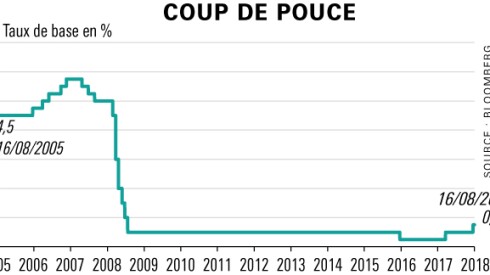
Volatiles. Le relèvement le 1er août par la Banque d’Angleterre (BOE) de son bank rate de 0,50 % à 0,75 % était anticipé par les analystes. La décision prise à l’unanimité (9 – 0) l’était beaucoup moins. La banque centrale a justifié sa décision par la situation du marché du travail et les meilleurs chiffres attendus des comptes nationaux au premier trimestre. L’éventualité de plus en plus importante d’un hard Brexit n’ont pas influencé les membres du comité de politique monétaire. Les économistes du Crédit agricole ne prévoient pas de nouvelle hausse avant le deuxième trimestre 2019. Les anticipations de marché laissent présager deux hausses au cours des trois prochaines années. Les analystes d’UniCredit qualifient cette hausse « d’erreur politique » et de « dovish », un resserrement de « colombe » et non de « faucon ». Thème en vogue, la banque centrale a publié pour la première fois son « r-star », un taux d’intérêt nominal d’équilibre à long terme (correspondant à la croissance potentielle et à la cible d’inflation de 2 %). Le taux neutre ainsi défini est compris entre 2 % et 3 %.
First State Investments a écrit fin juillet aux investisseurs du fonds First State Global Resources pour annoncer la liquidation de la stratégie et de l’équipe dédiée le 11 décembre 2018, rapporte InvestmentEurope. La société explique que, ces 20 dernières années, elle avait une équipe d’investissement spécialisée sur les valeurs minières et de l’énergie cotées en Bourse dans le monde. « Cette équipe gère le fonds ces 15 dernières années. Toutefois, la société pense que la classe d’actifs devient de plus en plus spécialisée (…) et a pris en conséquence la décision de sortir du secteur Global Resources ».
RBC Gestion mondiale d’actifs, fournisseur de services et de solutions de gestion de placements pour les investisseurs institutionnels, la clientèle fortunée et les particuliers, a annoncé lundi 20 août le lancement des portefeuilles obligataires RBC, qui permettent d’investir sur les marchés mondiaux des titres obligataires. Les portefeuilles obligataires RBC sont gérés activement par les équipes obligataires de RBC Gestion mondiale d’actifs, de Phillips, Hager & North gestion de placements et de BlueBay Asset Management. « RBC Gestion mondiale d’actifs s’est taillé une réputation de chef de file des solutions de placement en titres à revenu fixe (…) Ces trois nouvelles solutions à faible risque offrent une grande diversification et des rendements en revenu attrayants », a déclaré Doug Coulter, président de RBC GMA Inc. Les portefeuilles sont proposés en série F et ont des frais de gestion de 0,40 %. Le Portefeuille prudence d’obligations RBC privilégie les obligations canadiennes à court terme de catégorie investissement, mais investit aussi des montants modestes dans une diversité d’obligations mondiales de catégorie investissement, de titres à rendement élevé, de titres d’emprunt des marchés émergents et de devises de marchés émergents. Le Portefeuille d’obligations essentielles RBC mise sur les obligations de base mondiales de catégorie investissement et les actifs à rendement élevé. Il présente une forte pondération en obligations de base mondiales, en obligations de sociétés à rendement élevé, en obligations convertibles et en devises de marchés émergents, ainsi qu’en titres de créance de sociétés et d'État. L'élaboration de chaque portefeuille obligataire RBC commence par des placements dans des obligations canadiennes de catégorie investissement. Des placements dans des obligations mondiales d'État, de sociétés, à rendement élevé et de marchés émergents sont ensuite ajoutés pour améliorer le rendement et diversifier le risque. Pour accroître la diversification, chaque portefeuille comprend des placements en devises de marchés émergents - une catégorie d’actif unique sans duration et à rendement élevé - et en devises de marchés développés, comme le dollar américain. Rappelons que le groupe des sociétés de RBC GMA gère un actif de plus de 330 milliards de dollars américains et compte quelque 1 400 employés au Canada, aux États-Unis, en Europe et en Asie.
SEI Investments Canada vient de recruter Lucy Paglione en tant que gérante senior de portefeuilles clients pour son bureau de Toronto. A ce titre, la nouvelle recrue sera chargée de gérer les relations avec les clients canadiens sans but lucratif et à prestations définies de SEI. Lucy Paglione arrive du Teacher’s Pension Plan Fund à St. John’s, Newfoundland, où elle a mis en place la stratégie d’investissement du fonds et assurait la gestion quotidienne des investissements.