L'Europe confirme son attractivité pour les expatriés et domine le top 10 des destinations les plus prisées selon HSBC. Mais la France se laisse distancer et tombe à la 35ème place du classement.
p { margin-bottom: 0.25cm; line-height: 120%; } Transparency, a rising phenomenon in the universe of finance, can be expected to remain at the centre of concerns for hedge funds. Regulation by the Securities & Exchange Commission (SEC) counts for much in this development, as does the increasing sophistication of investors, the specialist website ValueWalk notes. Institutional investors are not the only ones to be demanding more transparency either, as smaller investors have also become much more demanding and no longer hesitate to request much more complete due diligence procedures. Against this background, ‘black box’ strategies are no longer the new black. Most hedge funds can no longer keep their proprietary trading strategies absolutely secret. After several years of underperformance, compared both with the equity and bond markets, investors no longer want to give hedge funds a completely free hand, and they are now required to explain their investment, risk management, decision-making and positioning processes much more than in the past. Another trend noted by ValueWalk is that fund selectors have gained power to the detriment of managers. Fund selectors now have authority given to them by investment committees to construct genuinely diversified portfolios. There has also been a renaissance in more collegial relationships with clients. The customer service role has become more substantial, in a further sign of the current trend toward increased transparency.
As the end of the year approached, inflows to mutual funds slowed considerably. Trends which could be seen since mid-November were still present, but investors also showed a fresh appetite for some bond strategies, which had often been ignored in the wake of the election of Donald Trump to the White House, due to the prospect of interest rate hikes and additional costs for non-US dollar borrowers.International bond funds posted positive net inflows for the second consecutive week, which had not been seen since mid-October, while European bond funds had their largest net inflows of the past 17 weeks, the global flow specialist EPFR Global noted in its weekly statement. The year can be expected to finish with USD93bn in net outflows from equities, the highest level since the 2008 crisis, Bank of America Merrill Lynch remarks in its weekly study, based on the data from EPFR Global.Bond funds overall have seen net inflows of USD3.4bn in the week to 28 December. Funds dedicated to high yield bonds and those specialised in bank loans between them attracted a net total of over USD3bn. The weekly Bank of America Merrill Lynch study points out that European bond funds have seen inflows of over USD1bn. Emerging market bond funds have seen further net outflows, but totalling only USD0.2bn. Equity funds of all regions combined have posted net outflows of EUR1bn, with a net outflow of USD1.6bn from US equity funds, while European equity funds have also seen outflows, but totalling a negligible USD40m. However, funds specialised in Japanese equities have finished the week with positive inflows of USD2.4bn, the highest in the past seven weeks, and emerging market equity funds have seen net outflows of USD2.5bn.
The British markets made hay of the pessimistic outlooks of Brexit opponents and took the FTSE to an annual gain of 14% for 2016, the best performance of any stock market in Europe. This was driven largely by mining and international stocks, which benefited from a rebound in commodity prices and from the depreciation of the pounds sterling.In the rest of Europe, the CAC 40 gained 4.86% in 2016, while the German Dax gained 6.9%. Meanwhile the Milan FTMib loat 10.2% for the year, driven down by its banking sector, whose index lost 38%, The Swiss SMI index lost 6.8%, while the Spanish Ibex lost 1.6%.In the United States, the outcome of the presidential elections of 8 November took US equities to new highs in the final weeks of 2016.The Standard & Poor’s 500 index gained 9.54% for the year, and as much as 12% with dividends reinvested. More than half of this performance was achieved in the period of less than two months following the election of Donald Trump. The Dow Jones gained 13.42% for the year, and more than 16% with dividends reinvested.The Nasdaq posted annual gains of 7.5%.
p { margin-bottom: 0.25cm; line-height: 120%; }a:link { } Assets under management in Chilean mutual funds have risen 7.6% in the first 11 months of the year to a total of USD2.96bn as of the end of November, according to the most recent statistics released by the Chilean fund association (AAFM). The number of funds available for sale stands at about 600.
p { margin-bottom: 0.25cm; line-height: 120%; } In the wake of the acquisition of an Australian cooper mine for USD210m, the private equity firm EMR Capital, based in Australia, is seeking new targets, preferably in Australia or Asia, the CEO of the firm, Jason Chang, has told Reuters. “A lot of investors are taking an interest in copper and our outlooks are positive in the short, medium and long term. But we also like gold, potassium and coke coal,” says Chang. EMR Capital was speaking following the recent acquisition of the Golden Grove copper mine from China’s MMG, the first acquisition made by the second fund from EMR, which was closed in November with USD680m to spend.
Dans le sillage du rachat d’une mine de cuivre australienne pour 210 millions de dollars, la société de capital investissement EMR Capital, basée au Australie, est à la recherche de nouvelles cibles, de préférence en Australie ou en Asie, a indiqué à l’agence Reuters Jason Chang, son directeur général. «Beaucoup d’investisseurs s’intéressent au cuivre et notre perspective est positive à court, moyen et long terme. Mais nous aimons aussi l’or, la potasse et le charbon à coke», a précisé Jaspon Chang.EMR Capital s’exprimait après le rachat récent de la mine de cuivre Golden Grove au chinois MMG, le premier réalisé dans le cadre du second fonds d’EMR, bouclé en novembre dernier avec un trésor de guerre de 860 millions de dollars.
Primonial a annoncé juste avant Noël la finalisation d'une nouvelle restructuration de son capital. Le fonds de capital investissement britannique Bridgepoint a fait son entrée à hauteur de 52,5% grâce à l'acquisition des parts de Latour Capital, de BlackFin Capital, d'une partie des salariés, et de la dilution du Crédit Mutuel Arkéa. Une recomposition surprise qui doit permettre au groupe de réaliser des acquisitions plus importantes et viser l'international. Stéphane Vidal, directeur général de Primonial, dévoile à Newsmanagers ses nouveaux objectifs.
Koji Nagai, responsable de Nomura Holdings, estime dans le Wall Street Journal que la gestion d’actifs a du potentiel de croissance et indique qu’il continuait à chercher des opportunités d’investissement. Le plus grand courtier du Japon a déjà acquis une participation de 41% dans American Century Investments pour environ 1 milliard de dollars en mai. «Nous avions une plateforme dans les actions japonaises et asiatiques, mais l’acquisition d’American Century nous a aidé à construire une autre plateforme aux États-Unis», explique Koji Nagai. Il rappelle par ailleurs que seulement 18% des actifs financiers des ménages japonais sont placés en valeurs mobilières.Il assure par ailleurs que «les investisseurs institutionnels étrangers se précipitent pour acheter des actions japonaises étant donné que le Japon est politiquement stable et que les actions sont moins chères que d’autres, alors elles seront achetées pendant encore un certain temps».
La Commission européenne a soumis à l'Esma, l'EBA et l'Eiopa des amendements à Priip, réglementation qui a suscité une levée de boucliers chez les professionnels de l'investissement. Mais ces derniers ne sont pas parvenus à s'entendre sur une position commune.
La croissance de l’activité manufacturière dans la région de Chicago a décéléré un peu plus que prévu en décembre, montrait vendredi l’enquête mensuelle auprès des directeurs d’achat réalisée par l’ISM Chicago. L’indice PMI de Chicago est ressorti à 54,6 ce mois-ci contre 57,6 en novembre, qui marquait un plus haut depuis janvier 2015. Il ressort en-deçà du consensus de 57,0 établi par Reuters mais reste solidement au-dessus de la barre de 50 qui marque la frontière entre croissance et contraction de l’activité.
"En plus des avantages fiscaux de l'assurance vie, CNP Assurances offre aux souscripteurs une liquidité à tout moment et de façon inconditionnelle. En cas de cession anticipée, la compagnie sera la contrepartie acheteuse", explique Laurent Jumelle, directeur de CNP Patrimoine.
Dans un entretien accordé à H24 Finance, Jean-Olivier Ousset; dirigeant et fondateur du Centre du Patrimoine explique pourquoi il utilise la gestion pilotée d'Edmond de Rothschild AM.
La CNCEF et la CNCIF ont signé un partenariat avec Interfimo, qui permettra aux professionnels de la gestion de patrimoine et haut de bilan de financer des opérations de croissance externe, de faciliter le regroupement de leur cabinet, ou encore de bénéficier d'un accompagnement lors de l'acquisition de locaux dédiés à leur activité.
Dans un entretien accordé à la Tribune de l'Assurance, Olivier Farouz, directeur général d'Arca patrimoine revient sur l’activité du courtier spécialisé en épargne, retraite et prévoyance. Une activité qui s'est concentré en 2016 sur les unités des compte, qui représentent 87 % de la collecte d'Arca patrimoine.
p { margin-bottom: 0.25cm; line-height: 120%; } Brexit is that way. For the first time in several years, the prices of residential properties in London have risen less quickly than the national average. They rose 4.5% in the past year, the same pace as in 2015, but their growth was markedly slower in London, where the increase was only 3.7%, compared with 12.2% in 2015, according to statistics released by Nationwide. A statement says that the average price of a real estate property reached nearly GBP206,000 in December 2016, comapred with GBP197,000 at the same time one year previously.
2016 may bring net outflows from the hedge fund sector for the first time since 2009, according to the specialist website ValueWalk. Assets are remaining above the USD3trn line, but November was the third consecutive month of outflows from hedge funds, totalling USD2.24bn, and bringing net outflows in the past three months to USD33.44bn. Since the beginning of the year, net outflows have totalled slightly over USD83bn, while the sector has seen net inflows of USD44.09bn in the first 11 months of 2015. In November, the worst-performing strategies were Managed Futures, which have finished the month with outflows of over USD4bn, followed by Long/Short Equity strategies (-USD1.43bn) and Macro (-USD1.20bn). However, multi-strategy funds have attracted USD2.28bn, and Event Driven strategies have attracted USD1.06bn.
p { margin-bottom: 0.25cm; line-height: 120%; } Are trustees guilty of negligence? Whatever the case, the members of boards of directorrs responsible for overseeing mutual funds are now under pressure, as investors in the United States are widely suspecting that trustees may not have acted in the interests of shareholders, the news agency Reuters reports. Some investors also esitmate that trustees, who often pocket hundreds of millions of dollars per year in remuneration, have been negligent, for example by not passing on economies of scale that could be achieved as funds grew to investors, or by not showing enough rigour in pricing. On the sensitive subject of commissions, a Morningstar study released in 2015 says that assets in the asset management sector had risen 143% over ten years, at a time when commissions rose 78%. These figures would seem to suggest that investors were not treated as well as companies. Lawsuits have been filed, and are still in progress, against giants in the sector including BlackRock and Pimco, who refute the accusations against them. Other actions against firms including Hartford Fund and American Funds were not successful, but did draw some criticism of trustees.
The Société financière IGM (IGM Financial), an asset management firm based in Canada, with assets totalling about CAD140m as of the end of November, on 29 December announced that it had acquired a 10% stake in China Asset Management Co. (China AMC) on behalf of its affiliate, Corporation Financière Mackenzie, The sale price totals about RMB2.4bn, or CAD468m, slightly over EUR330m. A statement says that Mackenzie will have an opportunity to icnrease its stake by 3.9% in January via a further acquisition agreement. The two operations involve separate non-strategic shareholders which are Chinese state-controlled businesses, a statement says.“This acquisition provides IGM Financial with a means to participate in the asset management sector in the world’s second-largest economy, which is growing quickly. It also allows us to diversify our activities outside Canada,” says Jeff Carney, chairman and head of management at IGM Financial. China AMC, founded in 1998, whose controlling shareholder is the Chinese broker CITIC Securities, is one of the largest asset management firms in China, and one of the fastest-growing. Assets under management at China AMC as of the end of June 2016 totalled nearly RMB1.099078trn, or CAD215bn (over EUR152bn). Since 31 December 2011, the firm has posted an annual growth rate of over 40%.IGM Financial has built business relationships with the Chinese asset management firm since 2011 via its affiliates Mackenzie and Groupe Investors. “Mackenzie has recently won a new mandate for global fixed income oriented to relative returns, which will be distributed via the distribution channel of China AMC. We think the synergy created, and others like it, will allow us to increase our business volume in institutional and retail markets in the two regions of the world concerned,” explains Barry McInerney, chairman and head of management at Mackenzie.The operation is expected to contribute to the profits at IGM Financial from its first complete year of participation. IGM Financial is planning to finance the operation both with liquidity and the issue of securities and/or preferred stocks during the first half of 2017, with the final conclusions subject to the usual legal requirements, including the approval of the Chinese regulatory authorities.
In its monthly statement, Syz AM reveals that following the unexpected election of Donald Trump to the White House, equity markets suffered a violent sectoral turnover. “The new President has promised significant investment in infrastructure and budgetary recovery measures, as well as a potential repeal of the Dodd-Frank law. Although the complete implementation of these projects will be difficult to guarantee at this stage, the market has experessed its satisfaction with a sectoral rebound.” Banks are up, as pro-cyclical measures oriented to a recovery had the effect of driving up interest rates and easing the pressure on profit margins in the banking sector. The insurance sector has also seen a rebound with expectations that reinvetment revenues will be driven up by an interest rate hike. Lastly, telecommunications and utility sectors have been among the big losers with trump and the recovery, as invetors favoured pro-cyclical stocks.
After climbing 9.5% in October, savings deposits in France, which pay no interest, have posted a further increase, with annual growth of 10.1% in November, to EUR824bn, according to the most recent statistics from the Bank of France concerning the evolution of money markets. Accounts which pay interest (A-type checking accounts, sustainable development accounts, housing savings accounts, employee savings policies, young persons policies and ordinary checking accounts) rose only slightly, with growth of 0.7% in November to EUR613bn. Fixed-date deposits with a duration of less than two years, however, declined by 8.5% to EUR130bn.
From 1 January 2017, China will nearly double the number of foreign currencies eligible for the composition of its benchmark index, which is used to structure the value fo the yuan. From Sunday this week, the number of currencies included in the China Foreign Exchange Trade System (CFETS) basket will rise from 13 to 24, CFETS has announced. “This modification will improve the mechanism for calculating the yuan benchmark index and make it more representative of the evolution of the market,” the body explains, adding that it is seeking to be less dependent on the US dollar.The 11 new currencies include the South Korean won, the South African rand and the Mexican peso.
Moon Hyung-pyo, l’actuel président du fonds de pension public sud-coréen NPS a reconnu avoir trempé dans le trafic d’influence présumé ayant conduit à la destitution de la présidente Park Geun-hye. Le procureur spécial chargé de l’affaire a déclaré le 29 décembre que Moon Hyung-pyo avait admis avoir fait pression sur le fonds de pension alors qu’il était ministre de la santé pour qu’il appuie la fusion de deux filiales de Samsung, une opération évaluée à 8 milliards de dollars, rapporte l’agence ATS. Moon Hyung-pyo était en détention préventive depuis mercredi matin. Le procureur a demandé sa mise en arrestation.La fusion entre Cheil Industries et Samsung C&T a renforcé le contrôle de la famille fondatrice sur le groupe Samsung. Elle est au cour de l’enquête ayant abouti le 9 décembre à la destitution par le Parlement de la Présidente. Ce vote doit désormais être confirmé par la Cour constitutionnelle, qui a 180 jours à compter de cette date pour la maintenir au pouvoir ou la démettre de ses fonctions.
La Société financière IGM (IGM Financial), une société de gestion basée au Canada dont les encours ressortaient à environ 140 milliards de dollars canadiens à fin novembre, a annoncé le 29 décembre avoir pris une participation de 10% dans China Asset Management Co (China AMC) par le biais de sa filiale Corporation Financière Mackenzie. Le montant de l’opération s'élève à environ 2,4 milliards de RMB, soit 468 millions de dollars canadiens ou un peu plus de 330 millions d’euros. Un communiqué indique que Mackenzie a la possibilité d’accroître sa participation de 3,9% en janvier par le truchement d’un autre accord d’acquisition. Les deux opérations font intervenir des actionnaires non stratégiques distincts qui sont des entreprises d’Etat chinoises, précise le communiqué."Cette acquisition donne à la Financière IGM l’occasion de participer au secteur de la gestion d’actifs de la deuxième économie mondiale, lequel est en croissance rapide. Elle nous permet aussi de diversifier nos activités à l’extérieur du Canada», déclare Jeff Carney, président et chef de la direction de la Financière IGM. China AMC, créé en 1998 et dont l’actionnaire de contrôle est le courtier chinois CITIC Securities, est l’un des plus grands gestionnaires d’actifs de la Chine et l’un de ceux dont la croissance est la plus rapide. Les actifs sous gestion de China AMC s’inscrivaient à fin juin 2016 à près de 1.099,78 milliards de RMB, soit 215 milliards de dollars canadiens (plus de 152 milliards d’euros). Depuis le 31 décembre 2011, la société a enregistré un taux de croissance annuel composé de plus de 40%. Cela dit, la Société financière IGM a noué des relations d’affaires avec la société de gestion chinoise depuis 2011 au travers de ses filiales Mackenzie et Groupe Investors. «Mackenzie s’est récemment vu confier un nouveau mandat à revenu fixe mondial axé sur le rendement relatif qui sera distribué par le canal de la plateforme de China AMC. Nous croyons que la synergie ainsi créée, et d’autres encore, nous permettront de faire croître notre volume d’affaires sur les marchés institutionnel et de détail dans les deux régions du monde concernées», explique Barry McInerney, président et chef de la direction de Mackenzie.L’opération devrait contribuer au bénéfice de la Financière IGM dès sa première année complète de participation. La Financière IGM prévoit de financer l’opération au moyen à la fois de liquidités et de l'émission de titres de créance et/ou d’actions privilégiées dans le courant du premier semestre 2017. L’opération devrait être bouclée au premier semestre 2017, sa conclusion définitive étant subordonnée aux exigences habituelles, dont le feu vert des autorités réglementaires chinoises.
Les investisseurs qui voulaient jouer le rebond des cours du pétrole cette année via un ETF ont dû être déçus. Le fonds indiciel coté U.S. Oil (USO), spécialisé dans le pétrole le plus populaire au monde, est passé complètement à côté de la remontée des cours de l’or noir, écrit Les Echos. En effet, cet ETF n’a gagné que 6,77% depuis le début de l’année. Dans le même temps, son indice de référence, le baril de pétrole texan, le WTI, a bondi de 46,84%. La faute reviendrait au phénomène technique du «contango », selon le journal, une situation anormale de marché entraînant des pertes lors des renouvellements de contrats sur les marchés dérivés. Le contango « a pesé sur les rendements des investisseurs, de telle sorte que même si la valeur nominale d’un contrat à terme a augmenté, maintenir sa position sur le pétrole avait un coût élevé », explique John Love, président de la société gérant USO, tout en rappelant que les investisseurs sur le marché physique de l’or noir doivent eux-aussi faire face à des coûts de stockage, d’assurance etc.La situation pourrait cependant s’arranger en 2017, la différence entre les prix du pétrole livrables dans un mois et ceux livrables dans un an ayant commencé à se réduire.
La société de capital investissement Main Street Capital a annoncé le 29 décembre sa sortie définitive du capital du transporteur routier Daseke suite à l’entrée de Hennessy Capital Acquisition Corp au capital de ce dernier. Hennessy devrait prendre une participation minoritaire dans Daseke, ce qui permettra à Main Street de solder sa participation dans la société. La transaction devrait être bouclée dans le courant du premier trimestre 2017.
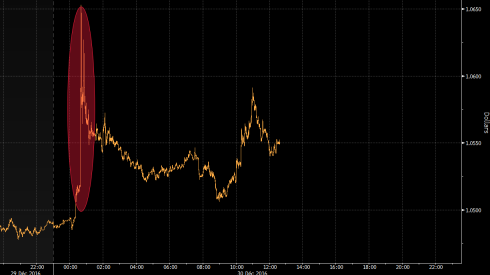
La monnaie européenne s'est élevée de plus de 1,6% vendredi matin sur les marchés asiatiques. Les analystes craignent que ces événements se multiplient à l'avenir.
Le nouvel aéroport international de Berlin, dont la construction a été entamée en 2006, n’entrera sans doute pas en service comme prévu l’an prochain, estime son directeur. Dans un entretien au Tagesspiegel, Karsten Mühlenfeld, estime que «des risques existent» de ne pas pouvoir respecter la date d’inauguration prévue fin 2017. D’après le journal Bild, la date d’inauguration a dû être reportée pour une cinquième fois, en raison de problèmes liés au réseau électrique.
La Corée du Sud a revu hier à la baisse sa prévision de croissance pour 2017 face à la dégradation de la demande intérieure et au ralentissement du marché du travail. Le gouvernement sud-coréen ne prévoit plus désormais qu’une croissance de 2,6% en 2017, contre 3% attendus jusqu'à présent, tandis que la banque centrale table sur une progression de 2,8% du produit intérieur brut (PIB), a déclaré hier le ministère des Finances. Le scandale politico-financier qui a abouti à un vote de destitution de la présidente Park Geun-hye a entraîné une nette dégradation de la confiance des consommateurs et des entreprises.
La Banque centrale européenne (BCE) doit débattre avec les autorités italiennes des raisons qui l’ont conduite à revoir en forte hausse son estimation des besoins de recapitalisation de Monte Paschi, a déclaré hier le président du Conseil italien, Paolo Gentiloni. «Il est important que les motivations de cette estimation soient évoquées lors des discussions des mois à venir», a-t-il dit lors d’une conférence de presse. Il a ajouté avoir été surpris d’apprendre le 25 décembre que la BCE souhaitait désormais voir la banque italienne combler un manque de fonds propres de 8,8 milliards d’euros, contre 5 milliards évoqués jusqu’alors. Le jour même, le ministre italien de l’Economie Pier-Carlo Padoan s’est montré lui très critique envers l’institution européenne. Il estime que celle-ci aurait dû expliquer plus clairement les raisons pour lesquelles elle a très fortement augmenté son estimation du déficit de fonds propres de Monte Paschi.