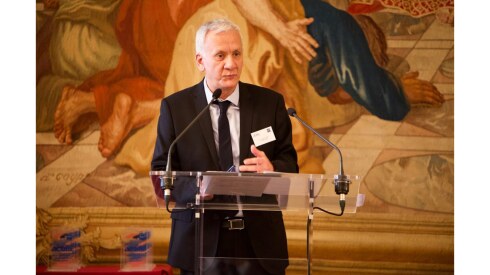
On Thursday, Union Bancaire Privée announced that it has recruited Michel Longhini, CEO of the international private bank at BNP Paribas since 2008, as CEO for its private banking division. Longhini will begin in his new position in early September, and will take a seat on the executive board at UBP. Longhini’s close ties to the Asia-Pacific region, where he worked for many years, are considered a prime advantage by his new employer, which is in the process of developing its activities in emerging markets with a central axis in growth strategy. He will primarily aim to open new markets in Asia, the Middle East and Eastern Europe.
DWS Investments has released three new funds domiciled in Luxembourg on the British retail market: DWS Invest Top Dividend, Diversified Fixed Income Strategy, and Global Thematic, according to Fund Strategy. DWS returned to the British market last year with a series of regional and thematic funds, after withdrawing from the market five years ago with the sale of its full range to Aberdeen Asset Management. To strengthen its coverage of the British market, DWS has also appointed Stephen Moore as head of sales for the United Kingdom. Moore was previously at Julius Bär Asset Management.
The German management firm Deka Immobilien has announced that it resold the office property St. James House in London to Standard Life on 1 July for EUR53.5m. The 3,317 square metre property was purchased for EUR45.5m in March 2003 for an institutional fund from Deka Immobilien; it is wholly leased to Jeffries International Ltd. It becomes the third property to be sold above market value by the management firm in three months (the first two were in Korea and Germany).
Prudential Real Estate Investors (Prei) and Mubadala Development Company have announced that they have signed an agreement to create a joint venture to raise capital from investors, with the objective of investing in real estate projects in Abu Dhabi and other international markets. The joint venture is entitled Mubadala Pramerica Real Estate Investors. As of 31 March this year, gross real estate assets at PREI totalled about USD43.8bn (USD22.8bn net).
As of 31 July 2012, Allianz Global Investors will close the Allianz PIMCO Genusscheinfonds (formerly cominvest Genusscheinfonds), which was launched on 16 July 2001, and which has assets of over EUR130m. Subscriptions and redemptions for the fund of entitlement warrant notes had been frozen since 3 March 2009. In light of the highly limited liquidity of the market segment, the assets in the fund could not be dispersed at suitable prices, while reopening the redemption window would most likely result in redemption requests that would exceed available liquidity. The date of liquidation has been set according to the maturity dates of most of the securities remaining in the portfolio.
The Securities and Exchange Commission (SEC) on 15 July announced that Goldman Sachs will pay a fine of USD550m and will modify its practices. The SEC says in a statement that it is the largest fine ever paid by a Wall Street firm. The SEC opened an investigation into transactions at Goldman Sachs related to sales of a sub-prime structured product related to real estate (CDO), at a time when the US real estate market was collapsing. It accused Goldman Sachs of concealing the role of the speculative fund Paulson & Co. in the selection of assets in the CDO, created in early 2007, from investors. Goldman Sachs ultimately admitted that information given to clients was incomplete.
According to estimates by Morningstar, US mutual funds posted net subscriptions in June of USD13.5bn, compared with net redemptions of USD13.2bn in May (see Newsmanagers of 14 June). Net inflows in January-June totalled USD166.7bn, 24% more than in the corresponding period of last year. Despite a decline for the MSCI EAFE index and concerns due to falling foreign equities markets, international equities funds posted net subscriptions of USD19.6bn in first half, while US equities funds saw net outflows of nearly USD17bn. Morningstar points out that alternative mutual funds, many of which have been launched since the credit crisis, have posted record net inflows, such as the Pimco Fundamental Advantage Total Return, which took in more than USD3.3bn in the 12 months to the end of June. However, money market funds lost USD790.5bn in assets in the 12 months to the end of June, of which nearly 80% of outflows were from institutional share classes. For ETFs, net subscriptions in June (USD9.9bn) brought total net inflows since the beginning of the year to USD34bn. Two two funds with the strongest net subscriptions in June were the SPDR S&P 500 SPY, with USD2.6bn, and the SPDR Gold Shares GLD, with USD2.1bn. Morningstar points out that aside from the MSCI Germany Index EWG and the iShares FTSE/Xinhua China 25, which were apparently used by investors repositioning themselves in view of the looming government debt crisis in Europe, the vast majority of single country ETFs saw net outflows in June.
The California pension fund CalPERS has reported estimated returns of 11.4% for the 2009-2010 fiscal year, ending on 30 June 2010. As of 30 June last year, the market value of the fund’s assets totalled USD200bn. “Excepting real estate, all asset classes earned positive returns this year,” sayd Joe Dear, chief investment officer at CalPERS, adding that an overhaul of investment policies, processes and strategies is on course. It has allowed CalPERS to save USD100m in fees to external managers, to remove the least well-performing funds from its portfolio, and to develop new risk management tools. In the various asset classes, fixed income has gained 19.5% in the fiscal year, private equity has gained 30.9%, and equities are up 14.4%. However, real estate was down 37.1% as of 31 March, and valuations as of the end of June have not yet been completed.
For January-June, the ABP pension fund for about 2.8 million public sector employees and teachers in the Netherlands has posted returns of 4.6%, and its assets as of 30 June totalled EUR218bn, compared with EUR208bn at the end of 2009, the Wall Street Journal reports. Gains are largely due to investments in corporate and government bonds, emerging markets equities, private equity and hedge funds. However, the coverage ratio for the fund has fallen to 95% at the end of June, compared with 104% at the end of December, while the legal minimum is 105%. This decline is largely due to historically low long-term interest rates.
On 9 July, the CNMV registered the Irish-domiciled Sicav Old Mutual Dublin Funds Plc from Old Mutual Asset Management (OMAM), including its sub-funds Global Bond Fund (bonds), Global Equity Absolute Return Fund, UK Dynamic Equity Fund and UK Select Smaller Companies Fund (equities). The products are available on the Allfunds Bank platform.
From 1 July, management commissions have been reduced for 36 products from The Hartford Mutual Funds (USD95.8bn as of 31 March). The asset management subsidiary of The Hartford has reduced fees for institutional, retirement and retail shares in the Diversified International, Fundamental Growth, Global Research, International Growth, International Opportunities and Value funds by 30 basis points. The objective is to put these funds in the foreground compared with their peers in their respective Morningstar categories, Keith Sloane, senior vice president at The Hartford Mutual Funds, announced on Wednesday. Fees have also been reduced by 15 basis points for institutional and retirement share classes in 30 other funds, with the goal of increasing institutional market share by targeting consultants and IFAs.
The Hamburg-based management firm Warburg-Henderson KAG has announced that for an undisclosed amount, which is nonetheless higher than market value, it has sold the office building Am Modenaplatz 1-2 in Vienna, which it acquired in 2002. The 9,500 square metre property was purchased in December 2002, and has since then generated an internal rate of return of 9% per year. It belonged to the portfolio of the institutional real estate fund Warburg-Henderson Österreich Fonds Nr 1, which currently has EUR230m in assets, and which is in a phase of divestment. It now owns five properties in Austria. Meanwhile, the German management firm has placed the Warburg-Henderson Österreich Fonds Nr 2 on sale; it will have a diversified portfolio of 10-15 office and commercial properties in the core/core plus segment, with an annual performance objective of 7%. The target volume, including leverage, is EUR300m; it is primarily aimed at German, Austrian and Swiss institutional investors.
On 29 October 2010 and 16 June 2011, DWS Investments will liquidate the DWS Hedge L/S Global Macro and DWS Hedge L/S Currency funds, its last German-registered hedge funds, the asset management firm from Deutsche Bank confirmed to Newsmanagers on Thursday evening. The DWS website actually states that the last date to accept subscriptions for the DWS Hedge L/S Global Macro fund, launced on 1 August 2005, was 30 June, and that assets now total only EUR0.01m. The performance of the fund has been 1.90% per year since its launch. However, the closure date for the DWS Hedge L/S Currency fund published by the Frankfurter Allgemeine Zeitung is not yet mentioned in the documentation for the fund (launched on 1 July 2004), which has assets of EUR10.42m. Performance has totalled 3.58% per year. DWS Investments had already liquidated the DWS Invest Dynamic fund last year, then, in April 2010, the DWS Hedge L/S Equity Opportunistic and the DWS Hedge L/S Market Neutral. Like other German asset management firms, DWS is reeling from the consequences of legislation which has complicated sales (warnings on documents, only private placement for single hedge funds). In addition, hedge funds have had a negative image in Germany since the “locust” controversy.
The Spanish Inversis Banco is marketing a structured product issued by Morgan Stanley which uses the Carmignac Patrimoine fund as its underlying, Funds People reports. The product guarantees 100% of invested capital after four years, plus 80% of the performance of the Carmignac Patrimoine fund during this period. Minimal subscription is set at EUR20,000, and the distribution commission is 3%. Inversis Banco is the sole distributor of the product until the end of the month.
The Santander Absolute Strategy fund, which Santander Asset Management has registered with the CNMV, becomes the first newcits fund from the management firm. It is a fund with daily liquidity, which invests in 15 to 25 UCITS III-format hedge funds. It will be available on the Allfunds Bank platform, and will be advised by Allfunds Alternative, Funds People reports. The objective is to achieve net annual performance of 5-7%, with volatility of 3-8%.
The global hedge fund index calculated by Greenwich Alternative Investments lost 0.84% in the month of June, while the S&P 500 lost 5.23%. However, merger and acquisition arbitrage strategies earned gains of 70 basis points, while bond arbitrage funds gained 1.06%. However, the long/short equity index lost 1.57%.
According to a survey by the consulting firm Preqin in June, more than one third of institutional investors in funds of hedge funds are planning to withdraw their money from the sector to reallocate it to single hedge funds, the Financial Times reports. Preqin finds that 80% of investors who have already withdrawn their money from funds of hedge funds did to after the beginning of the financial crisis in 2008. The most frequently cited reason for the withdrawals is high levels of fees.
D’après les statistiques de la CSSF publiées mardi, l’encours total net des organismes de placement collectif et des fonds d’investissement spécialisés (FIS) ressortait fin mai à 1.992,41 milliards d’euros contre 2.012,89 milliards au 30 avril, ce qui représente une diminution de 20,47 milliards ou de 1,02% sur un mois. En revanche, sur un an, les actifs sous gestion ont gonflé d’un peu plus de 23 %.La baisse d’encours en mai est imputable pour 5,62 milliards à l’effet négatif de marché et à 14,86 milliards de remboursements nets.
L’ancien patron de la gestion privée de la région de Francfort chez Deutsche Bank a rejoint Credit Suisse Deutschland comme directeur des activités au profit des particuliers très haut de gamme (UNHWI). Il succède à Wulf Matthias (65 ans) et a été remplacé à la Deutsche Bank par Daniel Hoster qui était dans la pratique en fonctions depuis mai.
La société de gestion colonaise Monega, filiale commune de DEVK, des banques Sparda et de Sal. Oppenheim créée en 1999, a désormais atteint 5,1 milliards d’euros d’encours pour ses fonds offerts au public sur mesures pour les institutionnels (Partnerfonds) et ses fonds institutionnels (Spezialfonds). Monega gère actuellement 15 Partnerfonds, dont cinq ont été lancés ces douze derniers mois, dont un produit de développement durable lancé pour la Sparda Bank de Munich et conseillé par Sarasin.
Le fonds de droit luxembourgeois Mandarine Unique R (LU0489687243) qui affichait au 12 juillet un encours de 18 millions d’euros, a obtenu son agrément de commercialisation en Allemagne par la BaFin le 16 juin. Ce fonds lancé le 29 mars 2010 investit en petites et moyennes valeurs européennes, sélectionnant des sociétés avec des business models uniques, présentes sur des niches avec des parts de marché mondial importantes.
Le gestionnaire d’actifs du LGT Group du Liechtenstein, LGT Capital Management, a ouvert mercredi sa première succursale commerciale en Europe hors Suisse à Francfort. Elle est dirigée par Marcus Perschke, qui était jusqu'à présent directeur de la distribution de M&G International Investments pour l’Allemagne.
Jörg Knaf, managing director de Natixis Global Associates (NGA) pour l’Allemagne et directeur de la distribution pour l’Allemagne, l’Autriche ainsi que la Suisse, le Benelux et la Scandinavie, reçoit du renfort. NGA a en effet recruté comme directeur de la distribution institutionnelle pour l’Allemagne Viktor Paul Pospiech, qui était directeur de la distribution et porte-parole du gestionnaire zurichois de hedge funds FiveT Capital. Il travaillera aux côtés de Tina Reinle, directeur de la distribution «wholesale».
Janus Capital International a annoncé le recrutement de Steven Bilodeau dans son équipe de ventes aux établissements financiers pour l’Europe germanophone (Allemagne, Autriche, Suisse). L’intéressé, qui doit être basé à Munich, était jusqu'à présent sales manager chez Threadneedle pour l’Allemagne. Il travaillera aux côtés de Thomas Doring et sera subordonné à Michael Jones, head of financial institutions pour l’Europe. Il sera chargé du développement de la clientèle parmi les gérants de fonds de fonds, les compagnies d’assurances, les caisses d'épargne, les banques populaires ainsi que les banques privées.
Generali Investments Deutschland vient d’annoncer la nomination de Mike Althaus au poste nouvellement créé de responsable de la distribution au travers des réseaux du groupe Generali en Allemagne.Mike Althaus travaille chez Generali depuis plus d’une dizaine d’années.
Mardi, le suisse Partners Group a annoncé avoir enregistré pour le premier semestre des souscriptions nettes de 3 milliards de francs contre 2,2 milliards pour juillet-décembre 2009 et 1,4 milliard pour la période correspondante de l’an dernier.L’encours au 30 juin est ressorti pour sa part à 26,5 milliards de francs suisses, contre 25,7 milliards fin décembre, en dépit d’une augmentation brute de 12 % des actifs sous gestion, car les pertes de change du fait de la dépréciation de l’euro contre franc suisse ont représenté 1,8 milliard de francs. Bien que les comptes de Partners Group soient libellés en francs, 70 % de l’activité s’effectue en euros contre 25 % en dollars et 5 % en d’autres monnaies.Actuellement, l’encours se subdivise en 19,9 milliards de francs (contre 20,2 milliards fin décembre) pour le private équity, tandis que la dette non cotée (private debt) représente 2,6 milliards contre 2,7 milliards. La poche immobilier non coté se situe à 0,7 milliard contre 1,4 milliard. En complément, Partners Group affiche 0,7 milliard de francs dans les infrastructures non cotées et 0,8 milliard dans les filiales.Urs Wietlisbach, co-fondateur et vice chairman, a indiqué que Partners Group, qui a déjà annoncé son intention de s’installer à Dubai (lire notre dépêche du 28 mai), compte ouvrir un bureau en Amérique latine et un autre en Asie.
Citigroup va transférer la gestion et certains de ses actifs «propriétaires» dans des fonds de fonds et des fonds de co-investissement en private equity à StepStone Group et Lexington Partners, indique The Wall Street Journal.Lexington acquiert les 1,1 milliard de dollars investis par Citigroup dans les fonds tandis que StepStone prend en charge les 4 milliards de dollars de fonds de fonds, de fonds nourriciers et de fonds de co-investissement.
Mercredi soir, GSO Capital Partners (29 milliards de dollars d’encours), le pôle «crédit» de The Blackstone Group, a annoncé la clôture finale du fonds GSO Capital Solutions avec des engagements d’investissement supérieurs à 3,25 milliards de dollars.Ce fonds a pour objectif de fournir hors marché des solutions en capital à des entreprises qui sont confrontées à des besoins de liquidités ou qui doivent faire face à des mutations importantes de leur structure de capital du fait de violations de convenants, d’arrivée à échéance de dettes ou de ralentissements cycliques de leur activité, par exemple.Jusqu'à présent, le fonds a investi environ 600 millions de dollars dans sept sociétés. Parmi les investisseurs, précise Blackstone, on trouve un groupe assez bigarré de fonds de pension américains et internationaux, de fonds souverains, de fondations et de family offices.
Blackstone Group et Carlyle Group seraient intéressés par l’acquisition de NBTY (ex Nature Bounty), une société qui fabrique des vitamines et des compléments alimentaires (marques Solgard, Rexall et MET-Rx), rapporte The Wall Street Journal. Le montant de la transaction pourrait dépasser les 3 milliards de dollar, mais on ne sait si les deux capital-investisseurs finiront par faire équipe ni si d’autres repreneurs sont en lice. La capitalisation boursière de NBTY est de l’ordre de 2,4 milliards de dollars et sa dette se monte à environ 450 millions de dollars tandis que son chiffre d’affaires s’est situé à 2,6 milliards de dollars, dont 60 % proviennent des ventes à des distributeurs comme Wal-Mart et Target. NBTY exploite aussi des magasins en direct, dont 440 sous l’enseigne Vitamin World aux Etats-Unis et 537 magasins Holland & Barrett en Europe.